
It’s one of the most common questions we get from travellers planning a Rajasthan tour: “Should I visit Jodhpur before Jaipur, or the other way around?”
Both cities are unmissable. Both are anchored by a magnificent Rajput fort. Both have old walled cities bursting with colour, chaos, street food, and centuries of history. And both will genuinely compete for the title of your favourite place in India.
But they are very different cities — in atmosphere, pace, architecture, and what they do best. The order you visit them in, and how much time you give each, will meaningfully shape your experience.
The short answer: visit Jaipur first, Jodhpur second — and here’s exactly why.
Jaipur: India’s Pink City and the Gateway to Rajasthan
Jaipur is the capital of Rajasthan and the natural starting point for almost every Rajasthan tour. It is bigger, busier, and more connected than Jodhpur — with excellent rail and road links to Delhi, Agra, and the rest of India.
What Jaipur does best
Jaipur is where Rajasthan puts its grandest face forward. The city’s three flagship sights — Amber Fort, the City Palace, and the Hawa Mahal — are among the most visited monuments in all of India, and rightly so.
Amber Fort is arguably the finest Rajput fort complex in the country. The intricate mirror work in the Sheesh Mahal, the views over Maota Lake, and the sheer scale of the fortified palace complex make it a full half-day on its own. Come early to beat the crowds and catch the morning light on the golden sandstone.
The City Palace is still partly home to the royal family of Jaipur and contains one of the best royal collections of arms, textiles, and art in Rajasthan. The Diwan-i-Khas (Hall of Private Audience) and its enormous silver urns — among the largest silver objects in the world — are genuinely jaw-dropping.
Jantar Mantar, the 18th-century astronomical observatory in the centre of the old city, is easy to underestimate on a map and extraordinary in person. The instruments are enormous, precise, and still functional.
The atmosphere in Jaipur
Jaipur is a proper metropolis of about four million people. The old walled city is hectic, colourful, and relentlessly commercial — the bazaars of Johari Bazaar (jewellery), Bapu Bazaar (textiles), and Tripolia Bazaar (bangles and metalwork) are among the best shopping in Rajasthan.
The pace is fast. The traffic is intense. It’s a city that rewards those who go looking for its quieter corners — the rooftop cafés overlooking the Hawa Mahal, the narrow lanes of the old city in the early morning before the stalls open.
How long to spend in Jaipur
Two full days is the minimum to do Jaipur justice. Three days is better if you want to visit Amber Fort properly, browse the bazaars at leisure, and take a half-day trip to Abhaneri stepwell or Sanganer for block-printing workshops.
Jodhpur: The Blue City That Gets Under Your Skin
Jodhpur is where many travellers have their most unexpectedly emotional moment in Rajasthan. It is smaller than Jaipur, quieter, and in many ways more authentically itself — less a city performing for tourists and more a living, breathing Rajput town going about its ancient business.
What Jodhpur does best
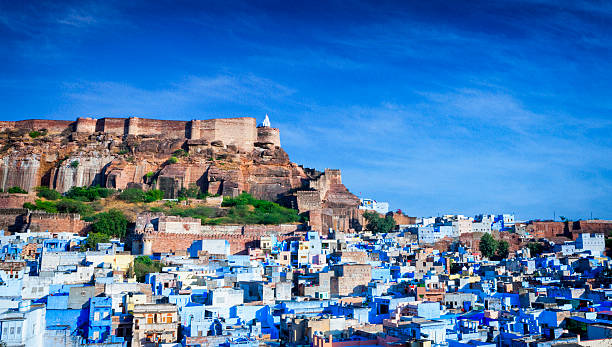
Mehrangarh Fort is, by many measures, the finest fort in Rajasthan — which is saying something in a state full of magnificent forts. It rises 120 metres above the old city on a sheer rocky outcrop, visible from almost everywhere in Jodhpur. The fort museum is exceptional — the palanquin gallery, the armoury, and the howdah collection are all world-class.
The views from the fort ramparts over the blue-painted houses of the old city below are among the most photographed sights in all of India. Come at sunrise or in the last hour before sunset for the best light.
The old city itself is Jodhpur’s real gem. The blue-washed houses clustered around the base of Mehrangarh create a neighbourhood unlike anything else in Rajasthan. Wander the lanes of the Brahmin quarter, find a rooftop restaurant with a direct line of sight to the fort, and simply sit with it for a while.
Jaswant Thada, the white marble cenotaph built in 1899 in memory of Maharaja Jaswant Singh II, is often skipped in favour of the fort — which is a mistake. The translucent marble glows in afternoon light, and the gardens offer a peaceful contrast to the energy of the old city.
The atmosphere in Jodhpur
Jodhpur has a completely different energy to Jaipur. The old city is navigable on foot, the people are noticeably more relaxed, and the tourist infrastructure is less intense. You’ll find exceptional rooftop restaurants, some of Rajasthan’s best cooking, and a pace of life that makes it easy to linger.
The market at Sardar Market and the clock tower area are lively without being overwhelming. The smell of mirchi bada and mawa kachori frying in the lanes around the clock tower is something you will not forget.
How long to spend in Jodhpur
Two days is comfortable. One long day is possible if your itinerary is tight, but you’ll feel rushed. The fort alone warrants three to four hours. Add the old city, Jaswant Thada, and a sunset rooftop dinner and you’ve got a full, satisfying day — but a second day lets you breathe and explore at your own pace.
Jodhpur vs Jaipur: A Direct Comparison
Here’s how the two cities compare across the factors that matter most to travellers:
Scale and pace
Jaipur is a large, fast-paced metropolitan city. Jodhpur is smaller and more manageable. If you find big Indian cities overwhelming, Jodhpur will feel like a relief after Jaipur. If you love the energy and chaos of a major city bazaar, Jaipur is more of it and at greater scale.
The forts
Both cities have world-class forts and it feels almost unfair to compare them. Amber Fort is larger and more elaborate in its interiors. Mehrangarh is more dramatically sited and its visual impact — rising sheer from the rock above the blue city — is arguably more powerful. Most travellers who visit both say Mehrangarh is the more emotionally affecting experience.
Food
Jodhpur wins this one for Rajasthani cuisine specifically. The old city around the clock tower is a street food destination in its own right — mirchi bada (stuffed green chilli fritters), mawa kachori, pyaz kachori, and lassi shops that have been running for generations. Jaipur has excellent food across a wider range of cuisines, but for authentic local Rajasthani street food, Jodhpur edges it.
Shopping
Jaipur is the undisputed shopping capital of Rajasthan — for jewellery, textiles, block-printed fabrics, blue pottery, and gemstones. If shopping is important to your trip, give Jaipur more time and save your budget for its bazaars.
Photography
Both are exceptional for photographers. Jaipur’s Amber Fort in morning light and the Hawa Mahal at golden hour are world-class. But Jodhpur’s blue city viewed from Mehrangarh — especially at sunrise — is one of the most photogenic scenes in all of Asia. If photography is your priority, lean toward Jodhpur.
Which City Should You Visit First — and Why
The conventional wisdom among experienced Rajasthan guides and tour operators is: Jaipur first, Jodhpur second.
Here’s the logic:
Jaipur is the natural entry point. It has the best transport connections from Delhi (by train, road, or air), making it the most logical first stop after arriving in India. Starting in Jaipur also means your body and senses acclimatise to Rajasthan at the more manageable pace of a city with good tourist infrastructure.
Jodhpur works better as a revelation than an introduction. By the time you reach Jodhpur — usually day four or five of a Rajasthan itinerary — you’ve already seen Amber Fort, the City Palace, and the grand sweep of Rajput architecture. Mehrangarh then arrives as a crescendo, a culmination. Its emotional impact is heightened by everything you’ve seen before it.
The classic Rajasthan circuit flows naturally west. The most logical touring route goes: Delhi → Jaipur → Pushkar → Jodhpur → Jaisalmer → Udaipur → back. This follows the geography, minimises backtracking, and builds toward progressively more remote and atmospheric destinations.
That said — if you’re flying into Jodhpur directly, or your itinerary runs east rather than west for logistical reasons, Jodhpur first works perfectly well. The cities are different enough that neither spoils the other.
FAQ: Jodhpur vs Jaipur
Is Jodhpur or Jaipur better for first-time visitors to India?
For absolute first-timers to India, Jaipur is the easier introduction — it has more international tourist infrastructure, a wider range of hotels at every price point, and is better connected to Delhi and other major cities. Jodhpur is slightly more off the beaten path and rewards travellers who already have some comfort navigating Indian cities. That said, neither city is difficult — both are well set up for international visitors.
How far apart are Jodhpur and Jaipur?
Jaipur and Jodhpur are approximately 340 kilometres apart by road, which takes around 5–6 hours by car or private driver. By train, the journey takes roughly 5–6 hours on the fastest services. Both options are comfortable, and the road journey through the Thar Desert fringes is scenic in its own right.
Can you visit both Jodhpur and Jaipur in one week?
Yes, easily. A week in Rajasthan gives you two days each in Jaipur and Jodhpur, with time to add Pushkar (between the two cities) or Jaisalmer (beyond Jodhpur). Most of The Explora Tours’ Rajasthan itineraries cover both cities comfortably in 10 days, which also allows for Udaipur and a desert camp near Jaisalmer.
Which city has better food — Jodhpur or Jaipur?
Both are excellent, but for traditional Rajasthani cuisine and street food, Jodhpur has the edge. The clock tower area and Sardar Market in the old city are particularly good for authentic local snacks like mirchi bada and mawa kachori. Jaipur is better for variety — you’ll find excellent restaurants serving everything from Mughal cuisine to contemporary Indian across a wider price range.
Is the Blue City of Jodhpur actually blue?
Yes — and it is more striking in person than any photograph suggests. The old Brahmin quarter clustered around the base of Mehrangarh Fort is densely painted in every shade of indigo and cornflower blue. The colour is traditionally explained as a marker of Brahmin households, though it also has practical benefits — blue paint repels insects and keeps the interiors cooler in summer heat. Viewed from the fort ramparts, the effect is extraordinary.
See Both Cities on Our Royal Rajasthan Tour
You shouldn’t have to choose between Jodhpur and Jaipur — the best Rajasthan tours include both, in the right order, with enough time to do each one justice.
Our Royal Rajasthan With Taj itinerary covers Jaipur, Pushkar, Jodhpur, Jaisalmer, and Udaipur across 10 expertly guided days. Every hotel is hand-picked, every guide is a specialist, and the route is designed so each destination builds on the last.
Prices start from $3,995 per person, inclusive of accommodation, private transfers, guided tours, and most meals.