
If you are visiting India for the first time and you have between one and two weeks, the Golden Triangle is almost certainly the right place to start.
Delhi, Agra, and Jaipur — the three cities that form India’s most famous travel circuit — sit within a rough triangle in the north of the country, each point approximately 200–250 kilometres from the others. Together they contain four UNESCO World Heritage Sites, the most photographed building in the world, two of the finest Mughal fort complexes in existence, a living pink-walled royal city, and a breadth of Indian history spanning the Delhi Sultanate, the Mughal Empire, and the Rajput kingdoms of Rajasthan.
The Golden Triangle gives you the political capital of modern India, the greatest monument to love ever built, and a Rajput palace city that looks like it was designed for a film set — all within a distance you can cover comfortably by road and rail in a week.
The standard route covers approximately 800 km, takes 3 days at a minimum, and costs between $250 and $900 per person depending on hotel category, transport, and inclusions. October to March is the ideal travel window.
This guide covers everything a first-time visitor needs to know: what the Golden Triangle actually is, how many days to spend, what to see in each city, how to get between them, what the current entry fees are, and what to do when the itinerary is done and you want to go further.
The direct answer for first-timers: seven to ten days is the ideal Golden Triangle duration. Seven days is comfortable. Ten days adds depth and breathing room. Anything under five days is rushed to the point of diminishing returns.
What Is the Golden Triangle India and Why Is It the Most Popular First India Trip?
What exactly is the Golden Triangle India tour?
The Golden Triangle route connects New Delhi, Agra, and Jaipur, offering a tour of India’s history and architecture. The triangle-shaped route links the capital city of New Delhi with the cities of Agra and Jaipur to the south, giving travellers a glimpse of India’s royal history, unique architectural styles, and diverse cultures.
The name comes from the geography — the three cities form a near-perfect triangle on the map of northern India. Each leg of the triangle is approximately 200–250 km, and the three cities form a near-perfect triangle on the map.
It has been India’s most popular tourist circuit for international visitors for decades, and for good reason: it concentrates an extraordinary density of world-class heritage into a manageable, well-connected, well-understood route that is accessible even to first-time visitors with no prior India experience.
Why do most India travel experts recommend the Golden Triangle for first-time visitors?
For foreign tourists, it covers four UNESCO World Heritage Sites, three royal capitals, and the country’s most photographed monument in one tightly planned circuit. Beyond the monuments, the Golden Triangle gives first-time visitors a structured, comfortable introduction to India’s intensity — the organised chaos of Delhi, the quieter Mughal atmosphere of Agra, and the palace-and-market energy of Jaipur — in a sequence that builds confidence progressively.
The infrastructure is excellent by Indian standards. Transport links between the three cities are reliable. English is spoken widely in tourist areas. Hotels at every price point are plentiful. It is the right starting point.
How Many Days Do You Need for the Golden Triangle India Tour?
What is the minimum number of days for the Golden Triangle?
The 3-day version is the minimum sensible duration. Anything shorter forces same-day return trips that defeat the purpose of seeing the Taj Mahal at sunrise.
That said, three days is genuinely very rushed — one day in Delhi, one in Agra, one in Jaipur leaves almost no room for the unexpected, for slower Exploration, or for the kind of unscheduled wandering that produces the best travel memories.
What is the ideal number of days for the Golden Triangle?
The breakdown by duration:
5–6 days (minimum comfortable): Two days in Delhi, one full day in Agra (Taj Mahal at sunrise, Agra Fort in the afternoon), two days in Jaipur. Covers the essentials without feeling punishing. Best for travellers with strict time constraints.
7–8 days (recommended for first-timers): Two days in Delhi, one and a half days in Agra (adds Mehtab Bagh, Itimad-ud-Daulah, and possibly Fatehpur Sikri), two and a half days in Jaipur (adds Abhaneri stepwell or Pushkar day trip). This is the sweet spot — enough time for each city to reveal itself properly.
10–12 days (the gold standard): If you have 4 or 5 days, add a half-day in Delhi at the start and a half-day in Fatehpur Sikri between Agra and Jaipur. A 10-day Golden Triangle allows for Fatehpur Sikri, a day in Pushkar, and the option to extend into Rajasthan via Jodhpur, Jaisalmer, and Udaipur — which is exactly what The Explora Tours’ Royal Rajasthan With Taj itinerary does.
What Should You See and Do in Delhi on the Golden Triangle?
What are the most important things to see in Delhi as a first-time visitor?
Delhi is a city of extraordinary contrasts — Delhi reveals contrasts between Old Delhi’s chaotic medieval lanes and New Delhi’s ordered colonial planning. Give it two days minimum. Here is what to prioritise:
Old Delhi — the medieval city:
Jama Masjid is India’s largest mosque, built by Emperor Shah Jahan in 1656. Climb the south minaret for a rooftop view of Old Delhi’s rooftops. The mosque can hold 25,000 worshippers and its scale is genuinely astonishing. Non-Muslims are welcome outside prayer times.
Chandni Chowk is one of the oldest and busiest markets in Asia — a kilometre-long bazaar of spice merchants, silver dealers, sari shops, sweet makers, and street food vendors that has operated since the 17th century. Walk or take a cycle rickshaw through Chandni Chowk. Give it a morning and follow your nose.
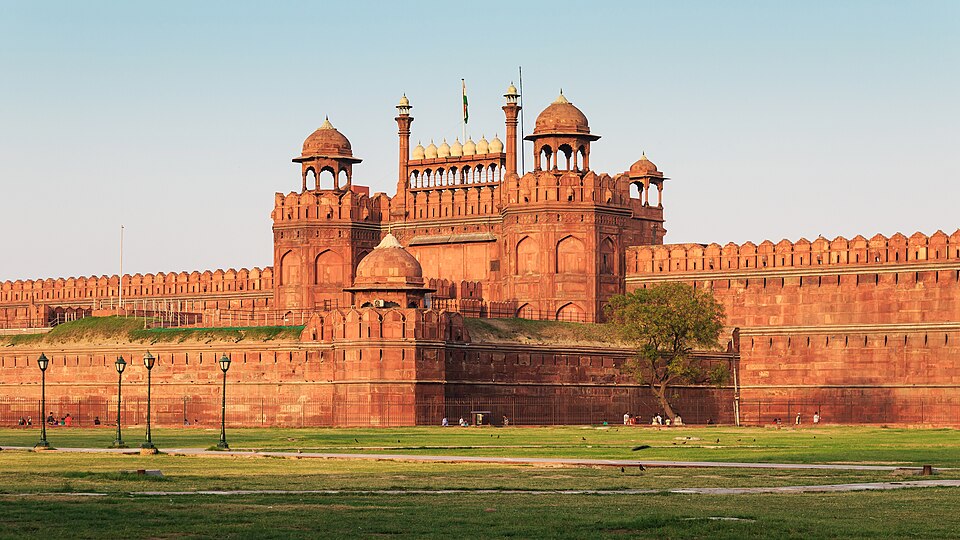
Red Fort (Lal Qila) is the great Mughal fortress built by Shah Jahan in 1638 as the centrepiece of his new capital Shahjahanabad. The red sandstone walls stretch two kilometres around a complex of marble palaces, audience halls, and gardens. Entry fee: ₹600 for foreign tourists.
Humayun’s Tomb in New Delhi is the architectural precursor to the Taj Mahal — a garden mausoleum built in 1572 for the second Mughal emperor, considered the first great example of Mughal architecture in India. The symmetrical red sandstone and white marble structure surrounded by its formal charbagh garden is one of the most beautiful buildings in Delhi. Entry fee: ₹600 for foreign tourists.
India Gate and Rajpath (Kartavya Path) are worth a late afternoon walk — the 42-metre war memorial at the end of the ceremonial boulevard, with the President’s House (Rashtrapati Bhavan) at the other end, gives the clearest sense of New Delhi’s imperial planning.
Qutub Minar — if you have time on a second day — is a 73-metre tower built in 1193 marking the first major Islamic monument in India. The complex around it contains the iron pillar of Delhi, standing since the 4th century without rusting. Entry fee: ₹600 for foreign tourists.
What Should You See and Do in Agra on the Golden Triangle?
What is there to do in Agra beyond the Taj Mahal?
Agra demonstrates how a single monument — the Taj Mahal — can justify an entire journey while surrounding sites add contextual depth.
The Taj Mahal is the centrepiece and needs no introduction. Entry fee: ₹1,100 for foreign tourists plus ₹200 for the mausoleum interior. Visit at sunrise through the East Gate for the best light and smallest crowds. See our full Taj Mahal tips guide for everything you need to know about visiting.
Agra Fort is a UNESCO World Heritage Site in its own right — a massive red sandstone Mughal fortress begun by Emperor Akbar in 1565 and completed by Shah Jahan, who spent his final years imprisoned here, gazing across the Yamuna at the Taj Mahal he built for his wife. The fort contains palaces, audience halls, and the balcony where the imprisoned emperor is said to have spent his days looking at the tomb. Entry fee: ₹650 for foreign tourists. Budget 2–3 hours.
Mehtab Bagh (Moonlight Garden) directly across the Yamuna from the Taj Mahal gives the finest alternative view of the monument — the rear elevation reflected in the river at sunset, from a garden that is almost entirely crowd-free. Entry fee: ₹300 for foreign tourists. Do not skip this.
Fatehpur Sikri — 40 km from Agra — is a complete Mughal city built by Emperor Akbar in the 1570s and abandoned shortly after. The Friday Mosque, the Buland Darwaza victory gate (54 metres high), and the palace complex are extraordinarily well preserved. Most Golden Triangle tours stop here en route from Agra to Jaipur. Entry fee: ₹610 for foreign tourists.
What Should You See and Do in Jaipur on the Golden Triangle?
What are the most important sights in Jaipur for first-time visitors?
Jaipur introduces Rajasthan’s royal heritage through architecture, markets, and living cultural traditions.
Amber Fort (Amer Fort) is the finest Rajput fort complex in Rajasthan and one of the most visited monuments in India — a tiered palace fortress of yellow and pink sandstone rising above Maota Lake with views across the Aravalli hills. The Sheesh Mahal (Hall of Mirrors) and the Ganesh Pol gateway are the architectural highlights. Entry fee: ₹550 for foreign tourists. Allow half a day and arrive at opening time.
The City Palace is still partly home to the royal family of Jaipur and contains one of the best collections of royal costumes, arms, and miniature paintings in Rajasthan. The Diwan-i-Khas and its two enormous silver urns — said to be the largest silver objects in the world — are particularly extraordinary. Entry fee: ₹700 for foreign tourists.
Hawa Mahal (Palace of Winds) is Jaipur’s most photographed building — a five-storey screen of 953 small windows built in 1799 to allow royal women to observe street life without being seen. It is one of those buildings that is more beautiful in person than in photographs. Entry fee: ₹200 for foreign tourists. Best photographed from the street café across the road.
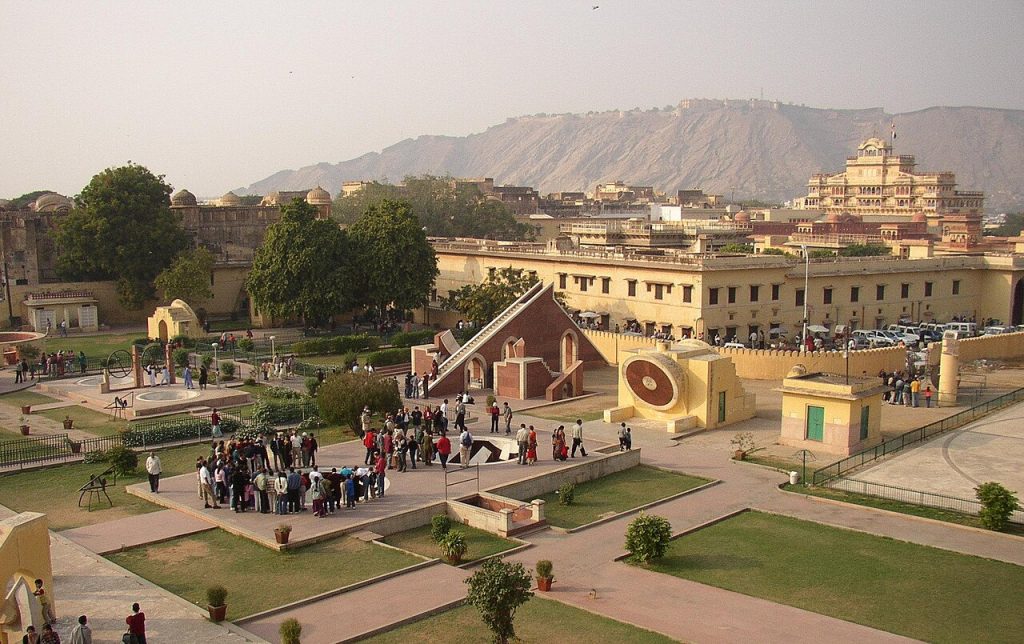
Jantar Mantar is the 18th-century astronomical observatory in the centre of the old city — 19 enormous stone instruments built between 1724 and 1734 that are still accurate enough to predict eclipses and measure solar time to within two seconds. Easy to underestimate, extraordinary to experience. Entry fee: ₹200 for foreign tourists.
The old city bazaars — Johari Bazaar (jewellery), Bapu Bazaar (textiles and block-printed fabrics), and Tripolia Bazaar (bangles and brasswork) — are among the finest markets in Rajasthan and worth an afternoon of unhurried browsing.
How Do You Get Between Delhi, Agra, and Jaipur?
What is the best way to travel between the Golden Triangle cities?
The optimal combination uses the Gatimaan Express for Delhi–Agra (fastest, most comfortable) and private car for Agra–Jaipur (flexibility for a Fatehpur Sikri stop).
Delhi to Agra: The Gatimaan Express is the fastest and most comfortable train option — the Gatimaan Express completes Delhi–Agra in 1 hour 40 minutes, costing ₹690–₹1,365 depending on class. Alternatively, the Shatabdi Express takes approximately 2 hours. Book IRCTC tickets 60–90 days in advance for peak season travel.
By private car, Delhi to Agra takes 3–4 hours via the Yamuna Expressway — comfortable, flexible, and allows stops at Sikandra (Akbar’s tomb) on the way. A private car with driver costs approximately ₹3,000–₹4,500 for the journey.
Agra to Jaipur: Private car is the recommended option for this leg — the 4–5 hour drive allows a natural stop at Fatehpur Sikri (approximately 45 minutes from Agra) and Abhaneri stepwell further along the route. A private car costs approximately ₹4,000–₹6,000.
By bus: Budget option with frequent Volvo services between all three cities — the Agra to Jaipur bus takes approximately 5–6 hours and costs around ₹350–₹600. Comfortable enough for those on a tight budget.
Jaipur to Delhi: The Shatabdi Express is the standard return option — approximately 4.5 hours, comfortable, reliable. A private car takes approximately 5–6 hours. Jaipur also has an airport (JAI) with frequent flights to Delhi (45 minutes) if you are continuing onward.
What Does the Golden Triangle India Tour Cost in 2026?
How much does the Golden Triangle India trip cost per person?
The standard route costs between $250 and $900 per person depending on hotel category, transport, and inclusions for a self-planned independent trip. Here is a more granular breakdown for 7 days:
Budget level ($60–$80/day, ~$450–$560 total): Guesthouses and budget hotels ($15–$25/night), local restaurants and street food ($10–$15/day), train and bus transport, self-guided monument visits.
Mid-range ($120–$180/day, ~$850–$1,260 total): Comfortable 3-star heritage hotels ($50–$80/night), good restaurants ($25–$40/day), private car transfers between cities, selected guided tours at major monuments.
Guided tour with specialist operator: The Explora Tours’ Golden Triangle Discovery runs over 8 days from $2,800 per person, inclusive of hand-picked accommodation, expert local guides, private AC transfers, Taj Mahal sunrise access, and most meals. This removes all logistical complexity — permits, drivers, guides, hotel bookings — and delivers significantly more depth at each site.
What Are the Best Day Trips and Extensions from the Golden Triangle?
Where should you go after the Golden Triangle?
The Golden Triangle ends most naturally in Jaipur — which is the gateway to Rajasthan. From Jaipur, extending the itinerary to include Pushkar, Jodhpur, Jaisalmer, and Udaipur adds some of the most spectacular destinations in India.
The Explora Tours’ Royal Rajasthan With Taj tour extends the Golden Triangle circuit into a full 10-day Rajasthan journey — covering Jaipur, Pushkar, Jodhpur, Jaisalmer, Udaipur, and Agra, with all logistics handled. This is the most natural evolution of the Golden Triangle for first-timers who want to go deeper.
Other worthwhile extensions: Ranthambore National Park (3 hours from Jaipur — tiger safari), Mandawa and the painted havelis of Shekhawati (2.5 hours from Jaipur), and Pushkar (the sacred lake city and camel fair town, 2.5 hours from Jaipur).
Frequently Asked Questions
What is the Golden Triangle tour in India?
The Golden Triangle is India’s most famous travel circuit, connecting three iconic cities: Delhi (the capital), Agra (home of the Taj Mahal), and Jaipur (the Pink City of Rajasthan). The three cities form a rough triangle on the map of northern India, with each leg approximately 200–250 km apart. The circuit covers four UNESCO World Heritage Sites and is the most popular introduction to India for first-time international visitors.
How many days do you need for the Golden Triangle India tour?
Seven to eight days is the ideal duration for the Golden Triangle India tour for first-time visitors. This gives two days in Delhi, one and a half days in Agra (including a Taj Mahal sunrise visit and Agra Fort), and two and a half days in Jaipur (Amber Fort, City Palace, Hawa Mahal, and the old city bazaars). Five days is the minimum for a comfortable experience. Ten days allows for Fatehpur Sikri, Pushkar, and the beginning of a Rajasthan extension.
What is the best time of year for the Golden Triangle India tour?
The best time for the Golden Triangle India tour is October to March, when temperatures are cool and comfortable (10°C to 25°C in Delhi and Jaipur, similar in Agra) and the skies are clear. December and January are the most popular months among international visitors. April to June is very hot — Agra in particular reaches 45°C+ in May and June — and is not recommended for most first-time visitors. The monsoon (July to September) brings rain and high humidity but lower prices and thinner crowds.
How do you get from Delhi to Agra on the Golden Triangle tour?
The best way to get from Delhi to Agra for the Golden Triangle tour is by the Gatimaan Express train, which completes the journey in 1 hour 40 minutes at a cost of ₹690–₹1,365 depending on class. Book IRCTC tickets at least 60–90 days in advance for peak season travel. Alternatively, a private AC car with driver takes 3–4 hours via the Yamuna Expressway and offers flexibility to stop at Sikandra (Akbar’s Tomb) en route.
Is the Golden Triangle India tour suitable for first-time visitors?
Yes — the Golden Triangle is specifically designed by its geography, infrastructure, and tourist development for first-time visitors to India. The route is well-established, English is widely spoken in tourist areas, hotels and transport are plentiful at every price point, and the circuit covers India’s most iconic sights in a manageable and logical sequence. For travellers who find India’s complexity daunting, travelling with a specialist tour operator like The Explora Tours removes all logistical concerns — permits, drivers, guides, and hotel bookings are arranged before departure.
Experience the Golden Triangle with Expert Guides
The Explora Tours’ Golden Triangle Discovery is an 8-day expertly guided tour of Delhi, Agra, and Jaipur designed specifically for first-time visitors to India. Every detail is handled before you leave home — Taj Mahal sunrise access timed for the best light, a specialist guide at every monument, private AC transfers between cities, and hand-picked accommodation that puts you in the right part of each city.
The tour includes Amber Fort, the City Palace, Humayun’s Tomb, the Red Fort, the Taj Mahal interior, Agra Fort, Fatehpur Sikri, and the old city bazaars of Jaipur — all with guides who know the history, the stories, and the best angles.
Prices start from $2,800 per person for 8 days, inclusive of accommodation, expert guides, private transfers, Taj Mahal entry, and most meals.
For those who want to go further — deeper into Rajasthan, through the desert cities and lake palaces — our Royal Rajasthan With Taj tour extends the Golden Triangle into a full 10-day Rajasthan journey from $3,995.