
If you are planning an India wildlife safari and trying to decide between Bandhavgarh and Kanha, you are asking one of the most enjoyable arguments in Indian travel — and it is genuinely contested.
Both parks are in Madhya Pradesh in central India. Both are Project Tiger reserves with thriving Bengal tiger populations. Both offer world-class jeep safaris with expert naturalist guides. Both have lodge accommodation ranging from comfortable to genuinely luxurious. And both will, in all likelihood, show you a tiger.
But they are meaningfully different places — different in size, landscape, atmosphere, tiger density, and the type of wildlife experience they deliver. Choosing between them comes down to what kind of safari you actually want.
Bandhavgarh National Park in Madhya Pradesh is famous for having the highest tiger density amongst all tiger reserves in the country. Kanha is the larger, more diverse park — Kanha is ideal for those who want more than just a tiger sighting. It is perfect for travellers who appreciate diverse wildlife, scenic landscapes, and a tranquil jungle atmosphere. If you are looking for a safari that feels like a deep, immersive nature experience, Kanha will win your heart.
Both parks are better than either alone. If you have the time and budget, visit both — which is exactly what The Explora Tours’ Ultimate Wildlife Tour does. But if you can only choose one, this guide will tell you which one.
The direct answer: choose Bandhavgarh if maximising your chances of a tiger sighting is the priority. Choose Kanha if you want a richer, more diverse wildlife and landscape experience overall. Visit both if you have 10 days.
What Are the Key Differences Between Bandhavgarh and Kanha?
How do Bandhavgarh and Kanha compare in size and tiger density?
Size and tiger density are the most significant practical differences between the two parks — and they are directly related.
Bandhavgarh covers about 1,536 square kilometres including both core and buffer zones, making it much smaller than Kanha, which leads to a more concentrated area for wildlife viewing. Kanha National Park spans a total area of 2,051 square kilometres, comprising a core zone of 917 square kilometres and a buffer zone of 1,134 square kilometres.
The practical implication: although Bandhavgarh’s overall area is limited compared to major wildlife destinations like Jim Corbett National Park or Ranthambore, it still has a greater density of Bengal tigers. More tigers in a smaller area means higher sighting probability per safari. If you go to Bandhavgarh specifically to see a tiger, the odds are strongly in your favour.
Kanha’s larger size means tigers have more territory — sightings are excellent but require more patience and more safari time. What Kanha’s size gives you in return is a more varied landscape and a significantly more diverse supporting cast of wildlife beyond tigers.
How do the landscapes of Bandhavgarh and Kanha compare?
The landscapes are genuinely different and they shape the feel of each safari experience significantly.
Bandhavgarh’s landscape is a striking mix of dense sal and bamboo forests, open grasslands, and rugged hillocks. Towering over it all is the legendary Bandhavgarh Fort, an ancient citadel that has witnessed centuries of history. The terrain is more dramatic — rocky outcrops, steep hillsides, and narrow valleys create a more intense, concentrated atmosphere. When a tiger emerges from the sal forest onto a rocky outcrop, the backdrop is extraordinarily photogenic.
Kanha is situated in the Maikal Hills of the Satpura range and offers a mosaic of open grasslands, lush sal forests, and seasonal streams. The park is famous for its rolling meadows — the great open meadows (maidans) of Kanha are among the most beautiful grassland landscapes in India, and they are where most of the wildlife activity takes place. Dawn on a Kanha meadow, with deer grazing in the mist and the forest edge lit by the rising sun, is one of the finest natural spectacles in the country.
Which Park Is Better for Tiger Sightings?
Does Bandhavgarh or Kanha have more tiger sightings?
What sets Bandhavgarh apart from other national parks is its exceptional record for tiger sightings. The relatively compact size of the park and the diverse habitat create ideal conditions for spotting these majestic creatures.
In practical terms: most experienced India safari guides consider Bandhavgarh the single best park in India for tiger sighting probability. The combination of high tiger density, compact area, and well-established tiger territories — many individual tigers are known to guides by name and can be tracked predictably — means that a morning safari at Bandhavgarh with an expert guide produces a tiger sighting more consistently than almost any other park in India.
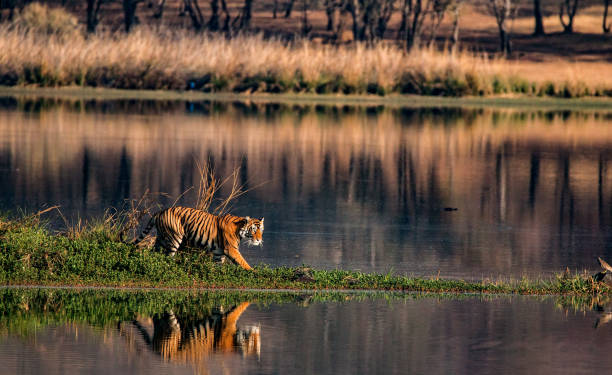
Kanha Tiger Reserve is famous amongst wildlife explorers because it offers consistent tiger sightings across its various zones. Wildlife photographers who are passionate about tiger photography mainly prefer it for capturing exceptional tiger moments. The open meadow terrain of Kanha often means better photographic conditions when tigers are seen — more light, more open ground, and more time with the animal before it retreats into the forest.
The honest summary: Bandhavgarh is better for the probability of seeing a tiger. Kanha is often better for the quality of the photographic experience when you do see one.
Which zones in each park give the best tiger sightings?
Bandhavgarh zones: The Tala Zone is Bandhavgarh’s most famous and most visited zone — highest tiger density, most experienced guides, and best infrastructure. It is also the most crowded during peak season. The Magdhi Zone is less busy and offers excellent sightings in a quieter atmosphere — a good alternative if Tala permits are unavailable. The Khitauli Zone is the largest but least visited zone and has lower sighting rates.
At the Tala zone in Bandhavgarh, visitors can also find many man-made or natural caves, old abandoned temples, statues, and rock-cut cave sites alongside the Bandhavgarh Fort ruins — making this the most historically layered safari zone in India. Walking between ancient Buddhist cave carvings and fresh tiger pugmarks is a uniquely Bandhavgarh experience.
Kanha zones: The Kanha Zone (also called the Kanha Meadows area) is the park’s most scenic zone — the great open maidans where barasingha (swamp deer) graze in the early morning and tigers move between the forest edges. The Kisli Zone is good for tiger sightings and has well-established tiger territories. The Mukki Zone in the south is the least visited and offers the most undisturbed wildlife experience — favoured by serious wildlife photographers.
What Wildlife Can You See Beyond Tigers at Each Park?
What non-tiger wildlife is Bandhavgarh best known for?
Aside from tigers, Bandhavgarh is home to a variety of fauna including leopards, sloth bears, Indian bison (gaur), and over 250 bird species. Leopard sightings at Bandhavgarh are particularly good — the park has a healthy leopard population and sightings are reasonably frequent for those who know where to look.
Bandhavgarh also has a remarkable historical dimension that no other Indian tiger reserve can match: the ruins of Bandhavgarh Fort and its associated cave temples, ancient statues, and rock carvings are located within the core forest area and are accessible on safari. Seeing a 2,000-year-old carved Vishnu statue in the middle of tiger country — surrounded by fresh wildlife signs — is something genuinely unique to this park.
Bandhavgarh was historically famous as the last refuge of the white tiger — a Bengal tiger with a recessive gene producing its distinctive pale colouration. The last wild white tiger was captured here in 1951 and taken to a zoo. While white tigers no longer exist in the wild, the historical significance of Bandhavgarh as their last stronghold adds another layer to its extraordinary character.
What non-tiger wildlife is Kanha best known for?
Kanha’s most famous wildlife achievement is the conservation of the barasingha — the swamp deer (Cervus duvaucelii branderi) that is Kanha’s emblem species and was brought back from the brink of extinction within the park. The hard-ground barasingha is found only in Kanha — nowhere else in the world — and seeing a large herd of these magnificent deer in the open meadows at dawn is one of the most moving wildlife encounters available in India.
Beyond barasingha, Kanha supports excellent populations of spotted deer (chital), sambar, gaur (Indian bison — the world’s largest bovine), wild dog (dhole), jackal, and striped hyena. The birdlife is extraordinary — over 300 species — and the park’s forest habitat supports an excellent diversity of raptors, including crested serpent eagle, changeable hawk-eagle, and the beautiful paradise flycatcher.
Kanha National Park is better for activity lovers as it allows activities like jeep safari, walking safari, and village visits — the walking safari in Kanha’s buffer zone is one of the most intimate wildlife experiences available in Madhya Pradesh.
How Do Bandhavgarh and Kanha Compare on Crowds and Atmosphere?
Is Bandhavgarh or Kanha more crowded?
Bandhavgarh tends to attract more tourists due to its reputation for tiger sightings, which can lead to more crowded safaris compared to Kanha. During peak season (November to March), the Tala Zone in particular can have multiple vehicles gathered around a tiger sighting — the gypsies line up in a semicircle at a respectful distance, which is managed and regulated but can feel busy compared to a more isolated sighting.
Kanha’s larger size and more spread-out safari circuit means vehicles are more dispersed across the park. The meadow zones can be busy during peak hours but the sense of space is greater. For travellers who prioritise an immersive, solitary jungle atmosphere over maximum sighting probability, Kanha’s size works in its favour.
The practical solution for Bandhavgarh: book morning safaris (starting before dawn — approximately 5:30–6:00 AM) rather than afternoon safaris. The morning slot is when tigers are most active and when the light is best, but it is also when the park is at its most atmospheric before the day crowds build.
What Is the Practical Comparison — Getting There, Safari Costs, and When to Visit?
How do you get to Bandhavgarh and Kanha?
Bandhavgarh: The nearest airport is Jabalpur (approximately 170 km away — 3.5 hours by road). Direct flights from Delhi and Mumbai to Jabalpur. Alternatively, Umaria is the nearest railway station (35 km from the park), connected to Jabalpur, Bhopal, and Delhi.
Kanha: The nearest airports are Jabalpur (approximately 175 km — 4 hours by road) and Nagpur (approximately 266 km — 5.5 hours). The nearest railway station is Jabalpur, from which private taxis run to the park gates.
Most India wildlife tour itineraries combine both parks using a single Jabalpur flight at each end — fly into Jabalpur, visit Kanha, drive to Bandhavgarh (approximately 260 km — 5–6 hours), then return to Jabalpur for departure. This is the standard routing used on The Explora Tours’ Ultimate Wildlife Tour.
What do safaris cost at Bandhavgarh and Kanha?
Safari costs at both parks are broadly comparable. A jeep safari (seating 6 guests plus guide and driver) costs approximately ₹3,500–₹5,500 per safari including park entry fees, guide charges, and jeep hire. Per-person costs for a shared jeep work out to approximately ₹700–₹1,200 per safari.
Premium wildlife lodges at both parks — properties like Taj Safaris, Samode Safari Lodge, or independent boutique lodges — include safari costs within their overall package, which typically runs ₹18,000–₹45,000 per person per night including accommodation, all meals, two daily safaris, and a resident naturalist.
When is the best time to visit Bandhavgarh and Kanha?
Both parks follow the same seasonal calendar. The parks are open from November to June and closed July to October for monsoon. The best visiting window for both is November to March — cool weather, lower vegetation for better sightlines, and wildlife concentrated around water sources.
November–December: Post-monsoon greenery, excellent wildlife activity, thin crowds. Very good sighting conditions. January–February: Peak season. Best combination of cool weather and low vegetation. Book accommodation and safari permits 6–8 weeks in advance. March–April: Tiger sightings peak as vegetation dries further. Temperatures begin to rise. April can be very hot (35°C+) but sighting conditions for tigers are exceptional. May–June: Very hot (40°C+). The parks close in late June. Not recommended for most visitors.
Which Should You Choose — and Should You Visit Both?
What is the final verdict on Bandhavgarh vs Kanha?
Here is the direct comparison for the specific traveller types most likely to be reading this:
Choose Bandhavgarh if: You have limited safari days (2–3 nights) and tiger sighting probability is your primary goal. You are interested in the historical dimension — ancient fort, cave temples, rock carvings within the jungle. You are a first-time India safari visitor who wants the most likely tiger encounter. You want the most intense, concentrated jungle atmosphere.
Choose Kanha if: You have 3–4 nights and want the richest overall wildlife experience. You are a wildlife photographer who wants open-meadow sighting conditions. You want to see the endangered hard-ground barasingha — found nowhere else on Earth. You prefer a more immersive, less crowded safari atmosphere. You value diverse wildlife as much as tiger sightings.
Visit both if: You have 6–8 nights in central India and want the definitive Madhya Pradesh safari experience. The combination of Bandhavgarh’s tiger density and Kanha’s landscape and biodiversity is genuinely greater than the sum of its parts — most experienced India safari travellers consider the two-park circuit the best wildlife itinerary in the country.
Frequently Asked Questions
Which Indian tiger reserve has the highest chance of seeing a tiger — Bandhavgarh or Kanha?
Bandhavgarh has the higher tiger sighting probability of the two parks. It has the highest tiger density of any tiger reserve in India — more tigers concentrated in a smaller area — and the park’s well-established individual tiger territories allow experienced guides to locate them consistently. Most guests on a 3-night Bandhavgarh visit see tigers on multiple safaris. Kanha offers excellent tiger sightings too, but the larger park area means they require more time and patience.
Are Bandhavgarh and Kanha both in Madhya Pradesh?
Yes — both Bandhavgarh National Park and Kanha Tiger Reserve are located in the state of Madhya Pradesh in central India. Both are accessible from Jabalpur Airport, which has direct flights from Delhi and Mumbai. The drive between Bandhavgarh and Kanha is approximately 260 km (5–6 hours by road), making it straightforward to visit both on a single central India wildlife circuit.
What is Kanha National Park famous for beyond tigers?
Kanha is famous for the hard-ground barasingha (swamp deer) — an endangered subspecies found only in Kanha National Park and nowhere else in the world. The park’s conservation programme brought the barasingha back from near extinction in the 1960s. Kanha is also celebrated for its extraordinary open meadow (maidan) landscape, its diverse birdlife (over 300 species), wild dogs (dhole), and gaur (Indian bison). It is considered one of the most beautiful and well-maintained national parks in India.
What is Bandhavgarh National Park famous for?
Bandhavgarh is famous for having the highest tiger density of any tiger reserve in India, making it the single best park in the country for tiger sighting probability. It is also historically significant as the last refuge of the wild white tiger (last captured here in 1951) and for the Bandhavgarh Fort and associated ancient cave temples and rock carvings within the core forest area — a uniquely historical dimension that no other Indian tiger park has. The park covers approximately 1,536 square kilometres including core and buffer zones.
Can you visit Bandhavgarh and Kanha on the same trip?
Yes — visiting both Bandhavgarh and Kanha on the same trip is the most popular wildlife itinerary in central India and is what most specialist India safari operators recommend. The two parks are approximately 260 km apart (5–6 hours by road) and are typically combined in a 6–8 night circuit, flying in and out of Jabalpur. The Explora Tours’ Ultimate Wildlife Tour combines Bandhavgarh, Kanha, and Kaziranga in a 14-day itinerary, giving guests the full breadth of India’s finest wildlife reserves.
See Both Parks on Our Ultimate India Wildlife Tour
You should not have to choose between Bandhavgarh and Kanha — the best India safari itinerary includes both.
The Explora Tours’ Ultimate Wildlife Tour combines three of India’s finest wildlife reserves — Bandhavgarh, Kanha, and Kaziranga — across 14 expertly guided days. You get Bandhavgarh’s tiger density, Kanha’s open meadow landscapes and barasingha herds, and Kaziranga’s one-horned rhinoceroses and elephant herds on the Brahmaputra floodplain — the full breadth of India’s extraordinary wildlife in a single journey.
Every safari is guided by specialist naturalists who know the individual tigers, the tracking techniques, and the best zones for each species. Accommodation is in hand-picked premium wildlife lodges within or adjacent to the park boundaries. Safari permits, internal flights, and all logistics are arranged before you leave home.
Prices start from $4,550 per person for 14 days, inclusive of luxury lodge accommodation, all safaris, expert naturalist guides, internal flights between reserves, and most meals.