
There are very few events in the world that genuinely earn the word spectacular. The Pushkar Camel Fair is one of them.
Every year, in the Hindu month of Kartik, the small desert town of Pushkar in Rajasthan transforms into one of the most extraordinary gatherings on Earth. More than 50,000 camels, horses, and cattle are brought to the desert plain on the edge of the town by nomadic herders and traders from across Rajasthan, Gujarat, and beyond. Alongside them come pilgrims seeking the holy waters of Pushkar Lake, folk musicians and dancers who have been performing at this fair for generations, camel traders in bright turbans, and travellers from every corner of the world who have heard about the fair and come to see whether it is as extraordinary as people say.
It is. And it is also something more than its reputation suggests — more human, more alive, more genuinely rooted in a way of life that has continued largely unchanged for centuries.
The Pushkar Camel Fair is one of Asia’s great spectacles — and it is also one of India’s most accessible festival experiences for international visitors. Pushkar is a small, walkable town. The fair grounds are adjacent to the town centre. And the combination of the livestock fair, the cultural performances, the sacred lake at the centre of the town, and the extraordinary desert light at this time of year creates something genuinely once-in-a-lifetime.
The confirmed dates for Pushkar Camel Fair 2026: November 17 to November 24, culminating on Kartik Purnima — the full moon night — on November 24.
What Are the Confirmed Pushkar Camel Fair 2026 Dates?
When exactly is the Pushkar Camel Fair in 2026?
The Pushkar Camel Fair 2026 runs from November 17 through November 24, with the spiritual climax occurring on Kartik Purnima — the full moon night — on November 24. The fair follows the Hindu lunar calendar, scheduled during the month of Kartik when pilgrims gather for sacred bathing.
For comparison, the fair dates across the next several years:
- Pushkar Fair 2026: November 17 – November 24
- Pushkar Fair 2027: November 6 – November 14
- Pushkar Fair 2028: October 25 – November 2
The dates shift each year because they are tied to the Hindu lunar calendar — the fair always concludes on Kartik Purnima (the full moon of the Kartik month). The 2026 edition runs comfortably in mid-to-late November, which is one of the most pleasant weather periods of the year in Rajasthan — cool mornings, warm sunny days, and cool clear evenings ideal for fair-going.
What happens on each day of the Pushkar Camel Fair?
The fair has two distinct phases that overlap but feel quite different:
Days 1–4 (November 17–20) — the livestock fair: The trading activities and camel competitions peak during the first four to five days. This is when the fair is most authentically itself — tens of thousands of animals on the desert plain, traders negotiating prices, camels being groomed and adorned for the beauty contests, horse races across the sandy ground, and the extraordinary visual of the dunes beyond the fairground covered in coloured tents as far as you can see. Arrive during this window if witnessing the livestock fair in full swing is your priority.
Days 5–8 (November 21–24) — the cultural and religious climax: The final days shift toward religious ceremonies, pilgrimage, and holy dips in Pushkar Lake. The cultural programme — folk dance and music performances, turban-tying competitions, traditional games — intensifies. November 24 (Kartik Purnima) is the emotional high point: pilgrims take a sacred dip in the lake at dawn, the ghats are illuminated, and the atmosphere of the whole town reaches its most charged and moving.
The ideal arrival date: November 17 or 18. This gives you the full spectrum — the authentic livestock trading days at the beginning, the cultural performances in the middle, and the Kartik Purnima full moon ceremony at the end. Five to six days covers the complete experience.
What Actually Happens at the Pushkar Camel Fair and What Should You Expect?
What is the Pushkar Camel Fair really like for first-time visitors?
The fair started as a small gathering of traders and pilgrims who came to Pushkar to trade camels and cattle. About a century ago, it expanded from a purely commercial livestock fair to include the cultural programme that international visitors now come specifically to see. Today it is simultaneously a working livestock market of genuine economic importance and one of the most vivid cultural spectacles in Asia.
The fairground — a large sandy plain known as the Pushkar Mela Ground, just beyond the town — fills up progressively from around November 10 onwards as traders begin arriving from across Rajasthan. By November 17, the official opening, the ground is covered in a sea of camels, horses, cattle, coloured tents, food stalls, craft vendors, and the constant sound of bargaining, music, and animals.
What you will actually see and experience:
The camel trading: The primary business of the fair. Camels are brought, groomed, adorned with decorative embroidery and bells, and traded. The haggling between buyers and sellers — sometimes involving a handshake, sometimes a lengthy negotiation — takes place in a scene of extraordinary colour and noise. Prices for individual camels range from ₹20,000 to over ₹2,00,000 depending on the animal’s quality.
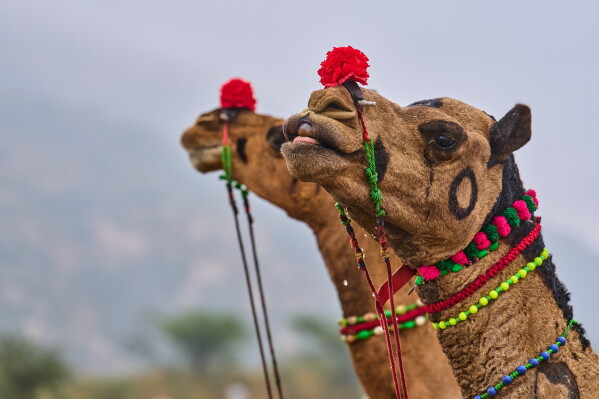
The camel beauty contest: One of the most beloved events of the fair — camels are decorated with coloured blankets, embroidered headgear, and painted patterns and paraded before judges. The crowd response to an especially magnificent camel is a genuine joy to witness.
The camel race: Races across the desert plain that kick up enormous clouds of dust and draw cheering crowds. Fast, chaotic, and spectacular.
The turban-tying competition: One of the fair’s most interactive events for visitors — teams compete to wind the longest or most elegantly tied turban in the shortest time, with commentary and crowd participation that makes it one of the most entertaining events of the week.
Folk performances: Every evening the cultural programme at the main stage brings Rajasthani folk dancers, puppet shows, fire dancers, and musicians performing the traditional music of Rajasthan — the sarangi, the dholak, the morchang — in performances that go on long into the night.
The hot air balloon rides: Since being introduced several years ago, hot air balloon rides over the fairground at dawn have become one of the most sought-after Pushkar Camel Fair experiences. From the air, the scale of the fair — the thousands of animals, the patchwork of coloured tents, the white town of Pushkar with its sacred lake at the centre, and the Aravalli hills forming the backdrop — is fully revealed. Book these well in advance; availability is limited.
What Is Pushkar and Why Is It Significant Beyond the Camel Fair?
What makes Pushkar special as a destination?
Pushkar is not merely the setting for the camel fair — it is one of the holiest cities in India in its own right, and visiting without understanding this dimension means missing the deeper layer of what makes the experience extraordinary.
Pushkar is home to one of the very few temples in the world dedicated to Lord Brahma, the creator in the Hindu trinity. The Brahma Temple, built in the 14th century at the centre of the town, draws pilgrims year-round and is particularly thronged during the Kartik month. Its distinctive red spire is visible from almost everywhere in town.
Pushkar Lake — the sacred body of water at the heart of the town — is believed by Hindus to have appeared where the lotus flower dropped from Brahma’s hand. The 52 ghats surrounding the lake are places of continuous prayer, ritual bathing, and ceremony. Watching the evening Aarti from the ghats — lamps floated on the water, priests chanting, the lake reflecting the last light of the day — is one of those experiences that stays with a person long after they leave.
Pushkar maintains complete vegetarian and alcohol-free zones in religious areas, respecting the town’s sacred status. The town’s cuisine is excellent — entirely vegetarian, ranging from traditional Rajasthani thali to the surprisingly good international food that has evolved over decades of catering to travelling visitors.
How Do You Get to Pushkar and Where Should You Stay?
How do you reach Pushkar from Jaipur or Delhi?
Pushkar is located 145 km from Jaipur — approximately 2.5 to 3 hours by road — and 398 km from Delhi (5–6 hours). The nearest railway station is Ajmer (14 km from Pushkar), which is well connected to Jaipur (1.5 hours), Delhi (5 hours), and Mumbai.
From Ajmer, take a taxi to Pushkar (approximately 30 minutes, ₹400–₹600). The Ajmer–Pushkar road passes through the Nag Parbat hills, a scenic approach that gives the first view of Pushkar Lake far below.
Most visitors from Jaipur take a private car — the most comfortable and flexible option, costing approximately ₹3,000–₹4,500 one way. The Explora Tours’ Royal Rajasthan With Taj itinerary includes a Pushkar stop between Jaipur and Jodhpur, which is the most natural routing.
When should you book accommodation for Pushkar Camel Fair 2026?
Book accommodation for the Pushkar Camel Fair 2026 immediately — by May or June 2026 at the absolute latest. The fair attracts over 200,000 visitors and accommodation in Pushkar is genuinely limited. Properties fill up months in advance for the peak November 17–24 window.
The accommodation spectrum in Pushkar is wide: budget guesthouses at ₹400–₹2,000 per night ($5–$25), mid-range heritage hotels at ₹3,000–₹8,000, and the Rajasthan Tourism Tent City erected specifically for the fair period at ₹8,000–₹20,000+ per night for full packages.
The Pushkar Tent City — a temporary luxury camp set up on the fairground perimeter specifically for the camel fair — is the most immersive accommodation option. Staying here puts you within walking distance of everything, gives you a desert camping experience that feels genuinely atmospheric, and typically includes cultural performances and guided fair visits as part of the package. Book directly through Rajasthan Tourism or a specialist operator.
Alternative: stay in Ajmer (14 km away) if Pushkar accommodation is fully booked — the drive in each day is manageable and Ajmer has a much larger hotel inventory. This is a viable fallback.
What Are the Most Important Tips for Visiting the Pushkar Camel Fair?
What should first-time visitors to the Pushkar Camel Fair know?
Arrive early in the fair, not late. The first four days (November 17–20) are when the fair is most authentic — the trading is active, the animals are most numerous, and the fair has its most genuine character. Many visitors who arrive only for the Kartik Purnima finale (November 24) miss the living, working fair entirely.
Get to the fairground at dawn. The most extraordinary light, the most atmospheric scenes, and the most photogenic moments all happen in the first hour after sunrise. Camel traders water their animals, the dust and the light create extraordinary conditions for photography, and the fair has a quiet energy before the crowds arrive. Rent a bicycle from town — it is the fastest and most enjoyable way to reach the fairground in the morning.
Respect the sacred spaces. Pushkar is a profoundly religious town. Remove shoes before entering the ghats. Do not touch the sacred lake without being invited. Do not photograph ceremonies or rituals without permission. Cover shoulders and knees everywhere in the town (not just at temples). Non-Hindus are generally welcome everywhere in Pushkar, and this welcome is best maintained by travelling with genuine respect.
The fair is entirely vegetarian and alcohol-free in the town itself. Embrace this rather than resist it — the food in Pushkar is genuinely excellent. The dal baati churma, the kachori, the lassi, and the Rajasthani thali available at the simple dhaba restaurants around the town are some of the best in Rajasthan.
Bargain at the craft stalls. The market that develops around the camel fair is extraordinary — embroidered textiles, silver jewellery, leather goods, puppets, block-printed fabrics, and camel leather products are available from vendors who travel to Pushkar specifically for the fair. The quality is variable; look carefully before buying and compare across several stalls. Bargaining is expected and appropriate.
Book your hot air balloon ride before you arrive. Balloon rides over the fairground at dawn are one of the most unforgettable Pushkar experiences and availability is genuinely limited. Book through your tour operator or directly with operators in Pushkar as early as possible.
Hire a local guide for at least one day. The fair has layers that are invisible without someone who knows what they’re looking at — the specific breeds of camel, the tribal identities of the herders from different regions of Rajasthan, the significance of the different ceremonies at the ghats, and the history behind the traditions. A local guide for a morning transforms understanding entirely.
Frequently Asked Questions
When is the Pushkar Camel Fair in 2026?
The Pushkar Camel Fair 2026 runs from November 17 to November 24, 2026. The spiritual climax of the fair occurs on Kartik Purnima — the full moon night — on November 24, when pilgrims take a sacred dip in Pushkar Lake and the entire town reaches its most charged and celebratory atmosphere. The best days to arrive are November 17–18, to experience both the livestock trading phase and the cultural climax.
What is the Pushkar Camel Fair and why is it famous?
The Pushkar Camel Fair — locally known as Pushkar Mela or Kartik Mela — is an annual multi-day livestock fair and cultural festival held in the town of Pushkar, Rajasthan. It is one of the largest camel fairs in the world, drawing over 50,000 camels, horses, and cattle for trading alongside more than 200,000 visitors annually. The fair is famous for its scale, its colour, its folk performances, its camel races and beauty contests, and its extraordinary combination of commercial livestock market and religious pilgrimage. It is widely considered one of Asia’s greatest and most visually spectacular festivals.
How many days do you need at the Pushkar Camel Fair?
Four to five days is the ideal duration for experiencing the Pushkar Camel Fair properly. This gives you two to three days at the height of the livestock trading phase, the full cultural programme in the evenings, and the Kartik Purnima ceremony at the end. Two days is the minimum for a meaningful experience. The Pushkar Camel Fair period also warrants a full day exploring the town itself — the Brahma Temple, the lake ghats, and the market lanes — independently of the fairground.
Where is Pushkar and how do you get there from Jaipur?
Pushkar is located in Rajasthan, approximately 145 km from Jaipur — about 2.5 to 3 hours by road. The most comfortable way to travel from Jaipur is by private car, costing approximately ₹3,000–₹4,500. The nearest railway station is Ajmer (14 km from Pushkar), which is 1.5 hours from Jaipur and 5 hours from Delhi by express train. From Ajmer, a taxi to Pushkar costs approximately ₹400–₹600 and takes 30 minutes.
What should you wear at the Pushkar Camel Fair?
Dress modestly throughout your time in Pushkar — the town is a sacred Hindu pilgrimage site and modest dress (covering shoulders and knees) is both respectful and expected. Comfortable, breathable cotton clothing is ideal during the day when temperatures can reach 25–28°C. Bring a warm layer for mornings and evenings, when temperatures drop to 8–12°C, particularly if you are planning to attend the dawn balloon rides or early morning fairground visits. Comfortable walking shoes are essential — the fairground is sandy and uneven. Bring a scarf or dupatta that can be used as a head covering at the ghats.
Experience the Pushkar Camel Fair as Part of a Rajasthan Tour
The Pushkar Camel Fair falls in the heart of the Royal Rajasthan With Taj touring season — and timed correctly, it fits naturally into the journey between Jaipur and Jodhpur with two to three nights in Pushkar at its most spectacular.
The Explora Tours’ Royal Rajasthan With Taj itinerary can be timed and customised around the November 17–24 fair dates — giving you the camel fair, the Kartik Purnima ceremony, the Brahma Temple, and the sacred ghats as part of a beautifully paced 10-day Rajasthan journey that also covers Jaipur, Jodhpur, Jaisalmer, Udaipur, and the Taj Mahal.
Accommodation during the fair period books out months in advance. If visiting the Pushkar Camel Fair is a priority for your India trip, speak to us as early as possible — we allocate a limited number of fair-period bookings and work on a first-confirmed basis.