
There are places in the world that earn their reputation entirely. The Golden Temple in Amritsar is one of them.
Officially called Harmandir Sahib — the Abode of God — and also known as Darbar Sahib, the Golden Temple is the holiest shrine in Sikhism and one of the most visited places of worship anywhere in the world. More than 100,000 people come here every single day — pilgrims, tourists, devotees, the curious, and those who simply needed somewhere to sit quietly by water and feel something they couldn’t quite name before they arrived.
What makes the Golden Temple extraordinary is not only the architecture — though the architecture is extraordinary. It is the combination of the architecture with the philosophy behind it. The temple has four entrances facing the four cardinal directions, open to all people regardless of religion, caste, gender, or nationality. Entry is completely free. And every single day, the temple’s community kitchen — the langar — serves free vegetarian meals to every person who walks in, whether they are a Sikh pilgrim who has travelled across India for this moment or a backpacker who didn’t know what langar meant until an hour ago.
The Golden Temple is home to the world’s largest community kitchen, which serves free food to approximately 100,000 people every single day. This is not charity. It is the living expression of one of Sikhism’s core principles — seva, or selfless service. Sitting cross-legged on the floor of the langar hall eating dal and chapati alongside pilgrims from every part of India, served by volunteers who have chosen to spend their day here doing this, is one of the most genuinely moving experiences available to a traveller anywhere in the subcontinent.
What Is the Golden Temple and Why Is It So Important to Sikhs?
What is the history of the Golden Temple in Amritsar?
The Golden Temple’s origins date back to the late 16th century, when Guru Arjan Dev Ji — the fifth Sikh Guru — oversaw its construction on a site in Amritsar that had been chosen by the fourth Guru, Guru Ram Das Ji. The foundation stone was laid in 1588, and the temple was completed in 1604. Guru Arjan Dev Ji also compiled the Adi Granth — the Sikh holy scripture — and installed it in the newly completed temple, making Harmandir Sahib its permanent home.
The temple was destroyed twice by Afghan invaders in the 18th century and rebuilt on both occasions. The gold plating of the upper floors was added by Maharaja Ranjit Singh in the early 19th century — approximately 750 kg of gold was used to cover the sanctum’s exterior, which is how the temple acquired its common English name.
The complex also houses the Akal Takht — the highest seat of earthly authority for Sikhs, where edicts on matters of community concern are issued — making Amritsar the spiritual and temporal centre of the Sikh world.
Why do people from all religions visit the Golden Temple?
Sikhism is explicitly a non-exclusive faith — it does not believe in conversion, does not consider other religions inferior, and actively welcomes people of every background to its places of worship. The four entrances of the Golden Temple — one on each side of the complex — physically embody this openness. The temple is not only a place of worship but a symbol of equality and hospitality, welcoming people from all backgrounds. Non-Sikhs are not merely tolerated at the Golden Temple. They are genuinely welcomed, fed, and treated with the same respect as any devotee.
What Are the Golden Temple Timings and Is Entry Really Free?
What time does the Golden Temple open and close?
The Golden Temple is open 24 hours a day, with free entry for all. The formal darshan (viewing and blessing) schedule runs from approximately 2:30 AM when the Granth Sahib (the holy scripture) is ceremonially brought to the sanctum, through the day’s rituals, to the Sukh Aasan ceremony at night when the scripture is reverently returned to the Akal Takht.
The Golden Temple timings on all days of the week are between 5:00 AM and 10:00 PM for the main visiting periods, though the complex is technically accessible around the clock.
What is the best time to visit the Golden Temple?
4:00–5:00 AM is the best time — minimal crowds, extraordinary light, and the most peaceful darshan experience available. In the hours before dawn, the golden exterior of the sanctum glows against the dark sky, reflected in the still water of the Amrit Sarovar (the sacred pool that surrounds it), and the sound of Gurbani kirtan (sacred music) from inside the sanctum drifts across the water in the quiet. It is a genuinely otherworldly experience.
Evening between 7:00–9:00 PM is the second-best timing, when the temple is illuminated and the reflection in the Amrit Sarovar is spectacular. At night, the gold exterior is floodlit, the water reflects it perfectly, and the atmosphere is deeply peaceful despite the crowds.
The best time to visit the Golden Temple on non-festival days is between 4 and 7 PM, when most people go to other tourist attractions, and the wait in the darshan queue can be as little as 30 minutes.
Avoid midday — the sun on the white marble surrounding the sarovar is intense, the queues for the sanctum are at their longest, and the atmosphere is least peaceful.
How long does the sanctum queue take?
The sanctum queue can be 2–4 hours on weekends and festival days. Darshan is brief — you pass through the sanctum for 1–2 minutes. Dawn queues are shortest. There is no fee and no fast track option — everyone waits equally. This is a deliberate expression of Sikh egalitarianism. The king and the beggar wait in the same line.
What Is the Langar at the Golden Temple and Should You Eat There?
What is the langar and how does it work?
The langar is the community kitchen of the Golden Temple — a free meal service that operates continuously, day and night, every day of the year. Guru Ka Langar runs all day and night, serving free vegetarian meals to every visitor.
The meal is simple and nourishing: dal (lentil soup), sabzi (vegetable curry), chapati (flatbread), and rice. You sit cross-legged on the floor in long rows alongside hundreds of other people. Volunteers move between the rows serving food from large vessels. When you finish, you leave, and the next person sits down. The kitchen serves approximately 100,000 meals per day — more during festivals — and is almost entirely run by volunteers, many of whom have come specifically to do seva (service).
Partaking respectfully is encouraged for all visitors regardless of religion or background. Donating to the langar (any amount) is appreciated but never required.
What should you know before eating at the langar?
The langar hall is entered through a separate gate in the temple complex. Shoes are left outside (there are free shoe storage facilities throughout the complex). You sit where you are directed. The food is brought to you. There is no menu and no choice — you eat what is served. If you are vegetarian, it is ideal. If you are not, note that the langar is strictly vegetarian and no exceptions are made.
The experience of eating in the langar — the scale of it, the orderliness, the genuine warmth of the volunteers, the completely non-hierarchical nature of the whole thing — tends to affect people in ways they didn’t anticipate. Most visitors come expecting a curiosity and leave with a memory.
What Is the Dress Code and What Are the Rules at the Golden Temple?
What do you need to wear and bring to the Golden Temple?
There is no specific dress code for visiting the Golden Temple, though tourists are advised to dress modestly and cover their heads with a scarf — this applies to both men and women. Free head coverings (orange cloth squares) are available at the entrance for those who arrive without one.
The rules are straightforward and must be followed:
Cover your head: Mandatory for everyone, at all times within the complex. A scarf, bandana, or the provided cloth squares all work.
Remove your shoes: Shoe storage facilities (free) are provided at multiple entrances. You will also need to wash your feet in the shallow channel at the entrance to the inner complex before entering.
No smoking, alcohol, or tobacco: Anywhere in the complex. This is strictly enforced.
Walk clockwise: Around the parikrama (the marble walkway surrounding the sarovar) and when approaching the sanctum.
Photography: Permitted in the outer complex and around the sarovar. Photography is permitted in designated areas, allowing guests to capture the temple’s beauty, especially at sunrise and sunset. Photography inside the sanctum itself requires restraint and sensitivity — follow the lead of those around you.
What Else Should You Do in Amritsar Beyond the Golden Temple?
Amritsar has more to offer than the Golden Temple alone — and a well-planned day or two covers all of it.
What is the Wagah Border ceremony and is it worth seeing?
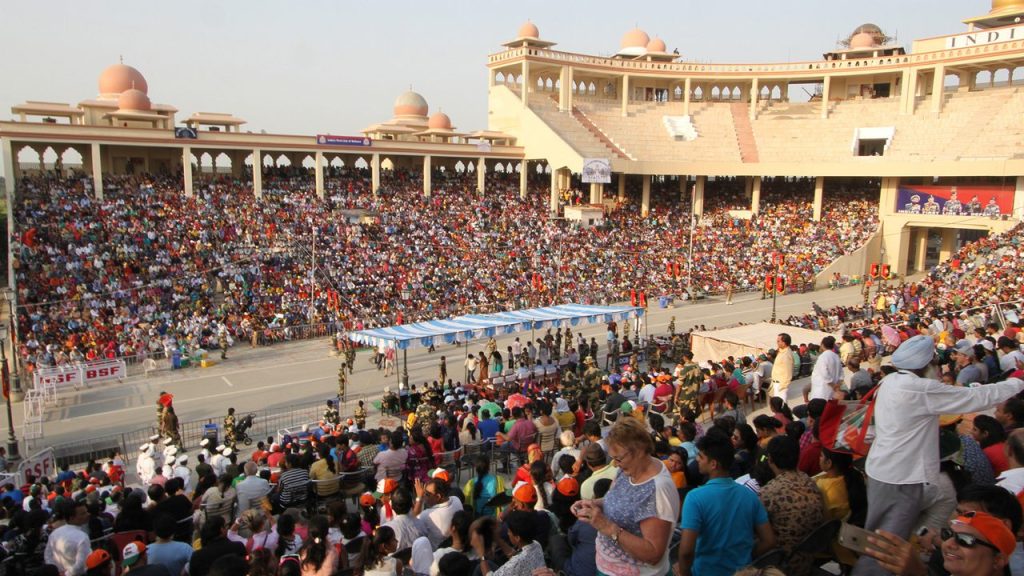
The Wagah Border Ceremony — also known as the Beating Retreat Ceremony — takes place every day at the border between India and Pakistan, 30 km from Amritsar city centre. Every evening, the Border Security Force of India and Pakistan Rangers perform an elaborate flag-lowering ceremony that is equal parts military precision, patriotic fervour, and theatrical performance — high kicks, dramatic marching, enormous crowds on both sides cheering their respective nations, and the simultaneous lowering of the two countries’ flags as the sun goes down.
The Wagah Border ceremony timings are around 5:00 PM in summer and 4:00 PM in winter. Entry is completely free. The ceremony lasts approximately 45 minutes.
Arrive at least one hour early to avoid crowds and carry a valid ID for security checks. Foreign tourists can claim seats near the VIP section for a better view — ask at the gate. Take a taxi from Amritsar (approximately 45–60 minutes, ₹600–800 return). The standard itinerary is: Golden Temple in the morning, Jallianwala Bagh and lunch in the city, then leave for Wagah Border by 2:30–3:00 PM.
What is Jallianwala Bagh and why does it matter?
Jallianwala Bagh is a public garden in Amritsar that was the site of the Jallianwala Bagh massacre on April 13, 1919 — one of the most significant atrocities of British colonial rule in India. On that day, British Indian Army troops under Brigadier-General Reginald Dyer opened fire on a large crowd of unarmed civilians who had gathered for a peaceful meeting, killing hundreds (estimates range from 379 in British records to over 1,000 in Indian accounts) and wounding more than 1,000.
The bullet marks on the walls and the martyrs’ well — into which people jumped to escape the firing — are haunting reminders of the sacrifice made for India’s freedom. The well, the bullet marks, and the memorial are preserved exactly as they were. The garden is a deeply sobering place to visit and essential context for understanding the independence movement and modern India’s relationship with its colonial history.
Timings: Open from 6:30 AM to 7:00 PM (summer) with a light and sound show in the evening. Entry is free.
What food should you eat in Amritsar?
Amritsar is one of the great food cities of India — the home of Amritsari cuisine, which is Punjab’s most generous and flavourful expression. The non-negotiables:
Amritsari kulcha with chole: Flaky, stuffed flatbread baked in a tandoor and served with spiced chickpeas — the definitive Amritsar breakfast dish. Amritsari kulcha with chole costs ₹60–80 at street level.
Lassi: Punjab’s lassi is different from its southern counterparts — thick, sweet, served in enormous clay pots. Lassi from Ahuja Milk Bhandar, one of India’s most famous lassi shops, costs ₹50–80.
Full Punjabi dhaba dinner: Dal makhani, butter chicken (Amritsar has no alcohol restrictions unlike parts of Rajasthan), tandoori roti, and paneer dishes at a quality dhaba. A full dinner at a quality dhaba costs ₹200–400 per person.
How Much Time Do You Need in Amritsar?
How many days should you spend in Amritsar?
Two days is the ideal duration. It gives you the Golden Temple at both sunrise and sunset, the Wagah Border ceremony at the right time, Jallianwala Bagh without rushing, and the old city lanes and food at a comfortable pace.
The perfect Amritsar itinerary runs: early morning Golden Temple darshan before dawn → breakfast (Amritsari kulcha) → Jallianwala Bagh → Partition Museum → lunch → depart for Wagah Border by 2:30 PM → Wagah Border ceremony → return to the Golden Temple in the evening for the illuminated view → langar dinner. That is an extraordinarily full and meaningful single day. The second day gives you time to slow down, sit longer at the sarovar, explore the old city lanes, and revisit the Golden Temple at a different hour.
Frequently Asked Questions
Is the Golden Temple free to visit?
Yes — entry to the Golden Temple is completely free for everyone, regardless of religion, nationality, or background. There are no tickets, no booking fees, and no fast-track charges. The langar (community kitchen) also provides free vegetarian meals to all visitors around the clock. The only costs you will incur are shoe storage (minimal, optional donation) and any transport to and from Amritsar.
What is the best time to visit the Golden Temple?
The best time to visit the Golden Temple is between 4:00 AM and 6:00 AM — before dawn and in the first light of morning. At this hour, the queues for the sanctum darshan are shortest, the light on the gold exterior and the Amrit Sarovar is at its most atmospheric, and the sound of Gurbani kirtan carries across the water in near silence. The second best time is after 7:00 PM, when the temple is illuminated and the evening atmosphere is deeply peaceful. Avoid midday, when queues are longest and the marble is scorchingly hot underfoot.
Can non-Sikhs visit and eat at the Golden Temple?
Yes, absolutely. The Golden Temple explicitly welcomes people of every religion, background, and nationality. Non-Sikhs are not merely permitted — they are genuinely welcomed, and the langar (free community kitchen) is open to everyone. The only requirements are to cover your head (free coverings are provided), remove your shoes, not bring alcohol or tobacco, and walk clockwise within the complex. The temple’s openness to all people is a core expression of Sikh philosophy, not an exception to it.
What is the Wagah Border ceremony?
The Wagah Border ceremony (officially the Beating Retreat Ceremony) is a nightly flag-lowering ritual performed at the India-Pakistan border 30 km from Amritsar. Soldiers from the Border Security Force of India and Pakistan Rangers perform a choreographed ceremony of high-kick marching, dramatic gate-opening, and simultaneous flag lowering at sunset. The ceremony is free to attend, runs approximately 45 minutes, and draws thousands of spectators daily — a uniquely theatrical expression of the India-Pakistan relationship that visitors consistently describe as one of the most memorable experiences of their India trip.
What should you absolutely not miss in Amritsar?
The four non-negotiables in Amritsar are: the Golden Temple at dawn (the most peaceful and beautiful experience the city offers), eating at the langar (a genuinely moving expression of Sikh philosophy in action), Jallianwala Bagh (essential historical context for understanding modern India), and the Wagah Border ceremony at sunset (one of the most extraordinary pieces of political theatre you will encounter anywhere in the world). Two days covers all four comfortably, with time for the old city food lanes and the Partition Museum.
Experience Amritsar as Part of Your India Journey
Amritsar sits at the northern edge of India’s most travelled circuit — an easy day’s travel from Delhi and a natural addition to any northern India itinerary. The Explora Tours can incorporate Amritsar into a custom itinerary built around your interests and travel dates.
Our Spiritual India Tour covers India’s most sacred and significant destinations over 10 days — including Varanasi, Rishikesh, and by extension the spiritual landscapes of northern India that Amritsar belongs to. Talk to our team about adding Amritsar to any northern India programme.