
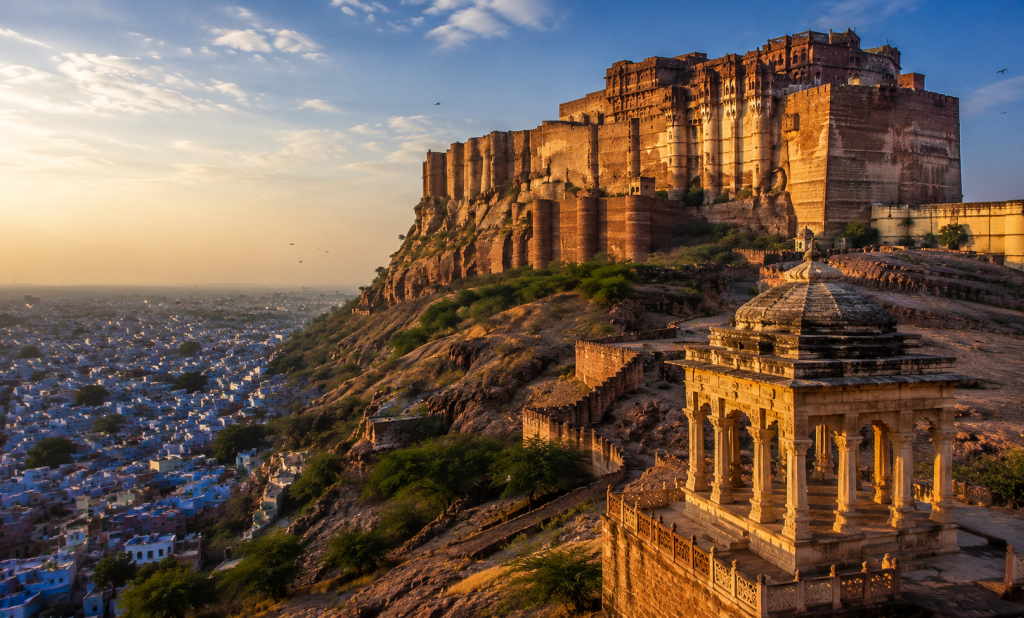
There is a moment every visitor to Jodhpur experiences — usually on the road from the old city, when the road bends slightly and the fort simply appears above you. Not gradually. Not gently. It rises sheer from the rock, 120 metres above the blue-washed rooftops of the old city, its walls so thick and its presence so complete that it looks less like something built and more like something that grew from the earth itself.
Mehrangarh Fort Jodhpur is, by wide agreement among those who have travelled India extensively, the finest fort in the country. This is a significant claim in a state full of magnificent forts — Rajasthan has Amber, Jaisalmer, Chittorgarh, and Kumbhalgarh, all extraordinary. But Mehrangarh Fort has something the others don’t quite match: the combination of sheer physical drama, extraordinary interior richness, exceptional museum curation, and the view from its ramparts over the blue city below that makes it feel like the definitive statement of what a Rajput fortress could be.
It also has, widely regarded as one of the finest audio guides anywhere in India — a piece of work that transforms an already remarkable visit into something genuinely illuminating. More on that shortly.
This guide covers everything you need to know before you visit: the history, the entry fees, the timings, what to see inside, how to use the audio guide, the best viewpoints, and the details that most visitors only discover when they’re already there.
The direct answer: give Mehrangarh a full half-day minimum — ideally arriving at 9:00 AM when the gates open, spending three to four hours inside, and finishing with the view from the northern ramparts in the mid-morning light. Do not rush this.
What Is Mehrangarh Fort and Why Is It Considered India’s Finest?
What is the history of Mehrangarh Fort and when was it built?
Mehrangarh Fort traces its origins to 1459 when Rao Jodha, the fifteenth ruler of the Rathore dynasty, founded Jodhpur and chose the Bhakurcheeria hill — the Mountain of Birds — as the site for his new capital’s fortress. The fort’s name derives from “Mihir” (sun) and “Garh” (fort), signifying the Rathore’s solar deity lineage.
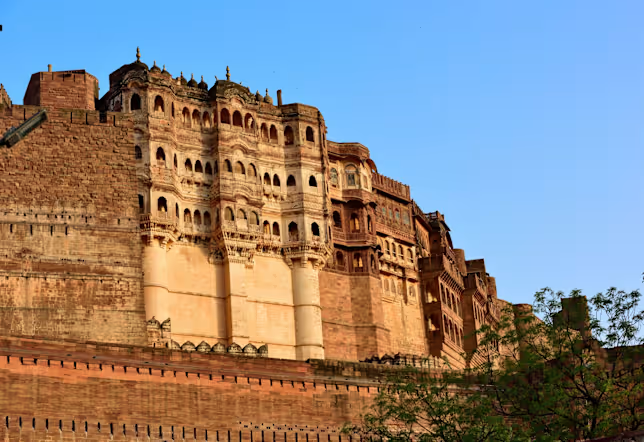
The founding came with a curse. Legend tells of Cheeria Nathji, a hermit residing on the hill, who cursed the fort’s construction when displaced. To pacify the hermit and lift the curse, Rao Jodha built a house and a temple for him nearby. The handprints of queens embedded in the fort’s walls — the sati marks of royal women who immolated themselves when their husbands fell in battle — are among the fort’s most haunting and quietly affecting details, visible near the Loha Pol (Iron Gate) as you enter.
While construction began in 1459, most of the fort visible today was built from 1638 onwards. This massive fortress was the centre of the Mewar Kingdom, which ruled over a land similar in size and borders to the modern-day state of Rajasthan. Its massive 120-foot walls protected the kingdom’s central buildings, including palaces for the king and close members of the royal family, administrative buildings, and the royal temple.
Over the following centuries, successive Rathore rulers expanded and embellished the fort — adding the great palace complexes, the audience halls, the zenana (women’s quarters), and the seven gates that lead from the base of the hill to the summit. Gates like Jai Pol and Fateh Pol were built to mark military victories. By the 18th century, the fort had evolved from a purely defensive stronghold into a grand royal residence, the cultural and administrative heart of the Marwar kingdom.
What Are the Mehrangarh Fort Entry Fee and Timings in 2026?
How much does it cost to enter Mehrangarh Fort in 2026?
As of 2026, the entry fee for Mehrangarh Fort is ₹800 for foreigners, which includes access to the museum, palaces, and all sections of the fort. For Indian citizens, the entry fee is ₹200. For an extra ₹180 (for foreigners and Indians), you can purchase the audio guide — one of the best decisions you can make for your visit. Tickets can be purchased at the ticket booth at the fort’s entrance or online in advance from the Mehrangarh Museum Trust website.
Additional activities within the fort:
- Zipline (Flying Fox): ₹2,000 per adult for two runs (100 metres and 310 metres) over the fort ramparts and the city below
- Elevator: A lift is available for visitors who prefer not to climb the stone approach — accessible from near the main gate
What are the Mehrangarh Fort opening times?
The fort is open to visitors daily from 9:00 AM to 5:00 PM. There are no days of closure — Mehrangarh is open every day of the year including public holidays and festival days.
Best time to arrive: 9:00 AM when the gates open. The morning light on the sandstone is at its most beautiful in the first two hours, the crowds are thinnest, and the cooler temperature makes walking the ramparts and climbing the palace steps comfortable. By 11:00 AM the tour groups arrive in numbers and the most popular sections become busy.
How long does a visit take? It’s a good idea to give yourself plenty of time to explore, as there’s a lot to see inside the fort. Plan to spend at least half a day if you want to thoroughly enjoy the exhibits, architecture, and views. Three to four hours is the ideal duration for a thorough visit. Rushing through in under two hours means missing the museum’s extraordinary collections and the quieter corners of the palace complex.
Why Is the Mehrangarh Audio Guide So Special?
Is the Mehrangarh Fort audio guide worth getting?
Yes — without reservation. The Mehrangarh audio guide is widely regarded as one of the finest monument audio guides in India, and many experienced India travellers rate it among the best they have encountered anywhere in the world.
The guide was produced to a genuinely high standard — it is not the generic narration that most monuments offer, but a layered, story-driven exploration of the fort’s history, architecture, and the human lives lived within its walls. It covers the approach through the seven gates, the story behind each gate’s construction, the palace rooms and their specific histories, the museum collections, the rampart views, and the details that even a knowledgeable guide might not explain in depth.
The audio guide costs an extra ₹180 for both foreigners and Indian nationals and can be purchased at the ticket booth alongside your entry ticket. It is available in multiple languages including English. The device is provided at the entrance and returned on exit.
How to use the audio guide effectively: The guide is numbered and keyed to specific spots throughout the fort — look for the numbered markers as you move through the complex. Do not try to rush ahead — the guide works best when you move at its pace, stopping at each marker and letting the narration finish before moving on. Allow yourself to be slowed down by it. The most rewarding Mehrangarh visits are the ones where the audio guide turns a spectacular backdrop into a fully understood story.
What Should You See Inside Mehrangarh Fort?
What are the most important things to see inside Mehrangarh Fort?
The fort’s interior is substantially larger than it appears from outside, and the quality of what it contains — both architecturally and in its museum collections — is genuinely extraordinary.
What are the seven gates of Mehrangarh and what is their significance?
The approach to the fort’s summit passes through seven gates — each one built at a different period of the fort’s history, and each carrying its own story.
Jai Pol (Victory Gate) was built by Maharaja Man Singh in 1806 to celebrate his victories over the armies of Jaipur and Bikaner. It is the first and grandest gate on the ascent and its name — Jai, meaning victory — sets the tone for everything that follows.
Fateh Pol (Gate of Victory) celebrates Maharaja Ajit Singh’s victory over the Mughals in 1707. The gate still bears the cannonball marks from the Mughal siege — a detail easy to miss without the audio guide pointing it out.
Loha Pol (Iron Gate) is the innermost and most historically significant gate — the point at which the royal women performed sati when their husbands fell in battle. The sati handprints of these queens, pressed into the stone of the gate at shoulder height as they passed through for the last time, are still clearly visible on the left side of the gate as you enter. They are one of the most quietly devastating historical details in all of Rajasthan — small, personal, and almost unbearably human in the context of everything the fort represents.
What is in the Mehrangarh Museum?
The Mehrangarh Museum is a treasure trove of royal artefacts, including weapons, costumes, paintings, and palanquins that reflect the opulence of Marwar rulers. It is one of the finest palace museums in India — not merely a collection of objects but a genuinely curated experience that explains who these people were and how they lived.
The highlights of the museum collections:
The Howdah Gallery contains the most extraordinary collection of elephant and camel howdahs (carrying seats) in India — intricate, jewelled, and enormous. The silver howdah used by the Maharajas of Jodhpur on ceremonial occasions is one of the most magnificent objects in the fort.
The Palanquin Gallery displays the royal palanquins used to carry members of the Marwar royal family — each one a masterwork of gilded wood carving and embroidered fabric. The variety of designs reflects different ceremonies and occasions.
The Armoury houses one of the most complete collections of Rajput weapons in existence — swords, daggers, shields, and firearms spanning five centuries, each with provenance and context provided by the audio guide.
The Phool Mahal (Palace of Flowers) is the most ornate of the fort’s private chambers — a reception room of extraordinary beauty with a gilded ceiling, painted panels, and the original furnishings of the Marwar royal court still in place. The detailing is so fine that standing in the centre of the room and looking up at the ceiling is genuinely vertiginous.
The Moti Mahal (Pearl Palace) was the private audience chamber of the Maharajas. The five niches in the walls, partially concealed by lattice screens, were where the Maharaja’s wives could listen to proceedings without being seen — a reminder that the social architecture of the fort was as carefully designed as its physical structure.
The Sheesh Mahal (Mirror Palace) is smaller than its equivalent in Amber Fort but no less extraordinary — every surface covered in tiny convex mirror fragments that catch the light from different angles simultaneously.
What Are the Best Views From Mehrangarh Fort?
Where are the best viewpoints and photography spots at Mehrangarh?
The views from Mehrangarh are among the finest of any monument in India — and significantly better than photographs suggest, because photographs cannot convey the scale or the quality of the blue that spreads below the ramparts.
The northern ramparts give the most complete view of Jodhpur’s old city — the dense cluster of indigo and cornflower blue-painted houses that give Jodhpur its name, the Blue City. The blue is most intense and most photographic in the soft morning light between 9:00 and 11:00 AM, when the sun is low enough to cast shadows between the buildings and the colour has depth rather than being bleached by midday overhead light.
The Chamunda Devi Temple terrace at the southern end of the fort gives a 180-degree view in the opposite direction — across the newer parts of the city, the Umaid Bhawan Palace on the distant hill, and the surrounding desert plain. The contrast between the ancient fort you are standing in and the Art Deco palace visible in the distance is one of the more remarkable visual juxtapositions in Indian travel.
The Takhat Vilas rooftop is a less visited section of the fort that offers an intimate close-range view of the fort’s internal courtyards and the blue city simultaneously — ideal for photography at a slightly different angle from the main rampart.
The zipline: For those who want the most extraordinary view of all — book the Flying Fox zipline. The run carries you over the fort’s walls and across a lake at 145 metres above the ground, with the blue city spreading in every direction and the Thar Desert visible beyond. At ₹2,000 for two runs, it is one of the better-value adventure experiences in Rajasthan.
What Are the Practical Tips for Visiting Mehrangarh Fort?
What should you know before visiting Mehrangarh Fort?
Arrive at opening time. Most travellers who don’t plan properly end up rushing. Enter before 10:30 AM for the best experience. The crowds build significantly from mid-morning and the most popular sections — the Phool Mahal, the northern ramparts — become very busy by 11:00 AM.
Wear comfortable shoes. The fort involves significant walking on uneven stone surfaces, steep steps, and ramps. Flat shoes or trainers are strongly recommended. High heels or sandals without straps are genuinely impractical.
Buy the audio guide without hesitation. At ₹180, it is one of the best-value decisions you will make anywhere in Rajasthan. The fort is magnificent without it. With it, it becomes comprehensible — and therefore much more moving.
The lift is available. For visitors who find the steep climb from the base of the fort difficult, a lift is available near the main gate. There is no reason to miss Mehrangarh due to mobility concerns — the upper sections of the fort are largely flat once you are inside.
Allow time for the Chamunda Devi Temple. The Chamunda Devi Temple is a revered shrine within the fort, visited by locals and tourists alike. It is an active place of worship — approach respectfully, remove shoes, and take a moment to observe rather than just photograph.
Visit Jaswant Thada afterwards. The white marble cenotaph built in 1899, a five-minute walk from the fort’s lower entrance, is the natural second half of a Mehrangarh morning. Its translucent marble glows in the afternoon light and the garden offers a quiet, shaded counterpoint to the intensity of the fort.
The rooftop cafés. The fort has a café within its walls with views over the blue city — ideal for a mid-visit rest. Several rooftop restaurants in the old city directly below the fort (reachable by auto-rickshaw from the fort’s lower entrance) serve excellent chai and light food with direct views of the fort from below — the complementary perspective to the view from above.
Frequently Asked Questions about Mehrangarh Jodhpur
What is the entry fee for Mehrangarh Fort in 2026?
The entry fee for Mehrangarh Fort in 2026 is ₹800 for foreign tourists and ₹200 for Indian nationals, including access to the museum, palaces, and all sections of the fort. An audio guide costs an additional ₹180 for both foreigners and Indians and is strongly recommended. Tickets can be purchased at the entrance ticket booth or online in advance through the Mehrangarh Museum Trust website.
What time does Mehrangarh Fort open and close?
Mehrangarh Fort is open to visitors daily from 9:00 AM to 5:00 PM, every day of the year including public holidays. The best time to arrive is 9:00 AM when the gates open — the light on the sandstone is at its most beautiful, the crowds are thinnest, and the temperature is most comfortable for exploring the ramparts and palace rooms.
How long should you spend at Mehrangarh Fort?
Three to four hours is the ideal duration for a thorough visit to Mehrangarh Fort. This allows time for the approach through the seven gates, all the main palace rooms and museum galleries, the audio guide at a comfortable pace, the northern rampart views over the blue city, and the Chamunda Devi Temple. Rushing through in under two hours means missing the museum’s extraordinary collections — the howdah gallery and armoury alone warrant 45 minutes.
Is the Mehrangarh Fort audio guide worth it?
Yes — the Mehrangarh audio guide at ₹180 is one of the finest monument audio guides in India and is worth getting without reservation. It provides a layered, story-driven exploration of the fort’s history, the significance of each gate, the context behind the museum collections, and the human stories — including the sati handprints at Loha Pol — that make Mehrangarh more than a beautiful backdrop. The guide is available in English and multiple other languages.
What is the best view of Mehrangarh Fort?
There are two distinct best views. From inside the fort, the northern ramparts give the most complete panoramic view of Jodhpur’s blue city — most photographic between 9:00 and 11:00 AM in the morning light. From outside the fort, the view from the rooftops of the old city below — particularly the Pal Haveli rooftop restaurant area — gives the complementary perspective of the fort rising sheer above the blue houses, most dramatic in the last hour before sunset when the sandstone turns golden amber.
See Mehrangarh as Part of a Royal Rajasthan Tour
Mehrangarh Fort is the centrepiece of Jodhpur — and Jodhpur is one of the highlights of The Explora Tours’ Royal Rajasthan With Taj tour, a 10-day journey through Rajasthan’s finest cities that gives you a full morning at Mehrangarh with an expert local guide who knows the fort’s history, stories, and the details that most visitors walk past.
Your Mehrangarh visit on our tour includes a guided walk through all seven gates with the stories behind each one, a full tour of the museum collections with expert commentary, the northern rampart views timed for the best morning light, and the Chamunda Devi Temple — followed by a rooftop lunch in the old city with the fort rising above you.
Prices for the Royal Rajasthan With Taj start from $3,995 per person for 10 days, inclusive of hand-picked heritage accommodation, expert guides, private transfers, and most meals.