
Rishikesh does not pick a lane — and that is precisely what makes it work.
In the same afternoon, you can walk from an ancient temple where priests have performed rituals for centuries to a bungee jumping platform. You can spend a morning in a serious meditation session at a Himalayan ashram and an afternoon bouncing through Grade IV rapids on the Ganges. You can eat at a rooftop café serving Italian-Indian fusion and watch the river glinting below you in the late mountain light. And in the evening, you can stand at Triveni Ghat as a hundred lamps are set on the water and the whole scene becomes something harder to name.
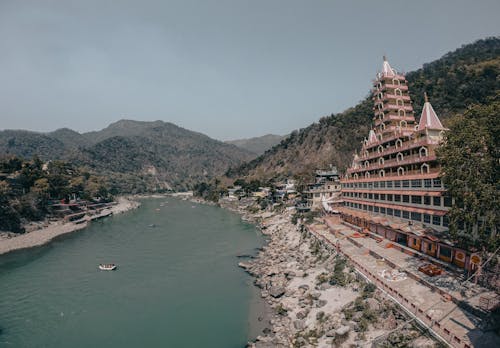
Rishikesh is where the Ganges descends from the Himalayas into the plains — where the river is still cold, clear, and fast from the mountains, not yet the wide, slow, ancient presence it becomes by Varanasi. The town sits in forested foothills at 372 metres above sea level, and on clear winter mornings you can see snow-capped peaks from the riverbank.
It is known as the yoga capital of the world. It is where the Beatles came in 1968. It is India’s white-water rafting hub. It is home to dozens of ashrams ranging from serious residential programmes to casual drop-in classes. It is one of the most visited towns in northern India — and somehow, despite all of this, it still manages to feel like a place genuinely worth being.
What Is Rishikesh and Why Do People Visit It?
Understanding what pulls people to Rishikesh helps you figure out which version of the place you’ve actually come for — because Rishikesh serves several very different types of traveller simultaneously and does each of them unusually well.
Why is Rishikesh called the yoga capital of the world?
Rishikesh earned the title of yoga capital of the world through decades of being the place where serious yoga and meditation study was available to international students — initially in the mid-20th century, when Indian yoga teachers began welcoming Western practitioners, and definitively after 1968 when the Beatles’ visit to the Maharishi Mahesh Yogi Ashram made it a global headline.
Today Rishikesh is home to hundreds of yoga centres and ashrams offering everything from a single drop-in class to month-long teacher training programmes. The serious ones — Sivananda Ashram, Parmarth Niketan, Phool Chatti Ashram — offer residential programmes with early mornings, simple vegetarian meals, and genuine discipline. The more accessible ones cater to travellers who want to experience yoga in the Himalayas for a morning before going rafting in the afternoon. Both are entirely legitimate reasons to come.
What kind of traveller is Rishikesh best suited for?
Rishikesh works for an unusually wide range of travellers: spiritual seekers doing serious yoga or meditation retreats; adventure travellers here for the rafting, bungee jumping, and trekking; curious tourists who want to understand a different side of India; Beatles fans making a pilgrimage; and anyone who simply wants a few days somewhere genuinely beautiful and unlike anything else in the world. The town is relaxed, walkable, alcohol-free (it’s a sacred Hindu city), and remarkably easy to navigate even for first-time India visitors.
What Are the Best Things to Do in Rishikesh?
From the two suspension bridges to the Beatles Ashram to the Ganga Aarti at Triveni Ghat, Rishikesh has more worth doing than two days will fully accommodate. Here is what to prioritise.
What is the Beatles Ashram in Rishikesh and is it worth visiting?
The Beatles Ashram — officially called Chaurasi Kutia (84 Meditation Huts) — is the single most distinctive attraction in Rishikesh and genuinely one of the most interesting places to spend an hour or two in all of northern India.
In 1963, Maharishi Mahesh Yogi established his International Academy of Meditation on 18 acres of forest land overlooking the Ganga in Rishikesh. He called it Chaurasi Kutia — 84 stone meditation cells arranged in rows under a canopy of sal and teak trees, with lecture halls, a meditation dome with extraordinary acoustics, and residential quarters. Everything changed in February 1968, when John Lennon, Paul McCartney, George Harrison, and Ringo Starr arrived with their wives and a small entourage for an advanced Transcendental Meditation course — they came on George Harrison’s recommendation, after he’d met Maharishi in London the previous year.
The Beatles spent three transformative months here in 1968, studying Transcendental Meditation and composing nearly 48 songs that would become the legendary White Album.
After the lease on the forest land ended in 1981, the ashram gradually became abandoned and was included in the protected forest zone. It was officially reopened for tourists in 2015. Today the site is a forest-set, partially ruined complex covered in extraordinary graffiti murals — an open-air gallery of psychedelic art wrapped around meditation domes, egg-shaped meditation pods, and the stone cells where the Beatles slept.
The Beatles Ashram entry fee is ₹1,200 for foreign tourists and ₹150 for Indian nationals, with visiting timings from 10:00 AM to 4:00 PM daily. Most guides suggest 30 minutes here. Give it at least an hour — the complex is larger than it appears from the entrance, and the atmosphere rewards slow Exploration. Visit in the morning for the best light and fewer crowds. A local guide at the entrance (₹200–300) is worth hiring for the stories about what actually happened here.
What is the Ganga Aarti in Rishikesh like and where is the best place to watch it?
The Ganga Aarti in Rishikesh takes place every evening at two main locations: Triveni Ghat and Parmarth Niketan Ashram. Both are worth experiencing, though they offer distinctly different atmospheres.
Triveni Ghat is the main public ghat in Rishikesh, where the Ganga, Yamuna, and the mythical Saraswati rivers are believed to meet. The evening Aarti here draws a large crowd of pilgrims, locals, and travellers, and the ceremony is deeply moving — lamps set on the water and carried downstream by the current while priests chant and bells ring across the ghat.
Parmarth Niketan Ashram is the largest ashram in Rishikesh and holds its own evening Aarti on its private ghat, which many travellers find more intimate and spiritually focused than the Triveni ceremony. The Parmarth Aarti is particularly well regarded for the quality of the bhajan singing and the atmosphere of genuine devotion rather than performance.
Both Aartis take place around sunset — check the specific timing on the day you visit, as it shifts with the season.
What are the suspension bridges of Rishikesh — Ram Jhula and Lakshman Jhula?
Ram Jhula and Lakshman Jhula are the two iconic pedestrian suspension bridges that span the Ganges in Rishikesh, offering spectacular views of the river and the ashrams and temples clustered on both banks. They are among the most photographed spots in the town.
Lakshman Jhula (the longer of the two at 450 feet) is the bridge most associated with Rishikesh’s postcard image — the 13-tiered Trayambakeshwar Temple rises directly behind it on the eastern bank. Ram Jhula sits closer to the main ashram district and gives views along the river toward the mountains upstream. Both bridges are pedestrian and motorbike only — the crossing itself, with the river visible through the bridge slats far below and the Himalayas in the distance, is one of the simplest pleasures Rishikesh offers.
How Does White-Water Rafting Work in Rishikesh and What Does It Cost?
Rishikesh is the undisputed white-water rafting capital of India, drawing thousands of adventure travellers annually to its Ganges rapids — some of the most accessible quality rapids in Asia.
What rafting routes are available in Rishikesh and which should you choose?
Rafting in Rishikesh is organised by stretch — the longer the stretch, the more rapids, the higher the difficulty, and the higher the cost. The main options in 2026 are:
9 km stretch (Brahmpuri to Rishikesh): The gentlest option, suitable for beginners and families. Features mild Grade II–III rapids. Takes approximately 1–1.5 hours. Cost: from ₹600 per person.
16 km stretch (Shivpuri to Rishikesh): The most popular option for first-timers and casual adventurers. Includes Grade III rapids with a few bigger drops. Takes 2–3 hours including time on the water and on the beach between rapids. Cost: from ₹800–1,200 per person.
26 km stretch (Marine Drive to Rishikesh): For those who want a full day on the river. Includes some of Rishikesh’s best rapids — Golf Course, Club House, and Three Blind Mice. Takes a full day. Cost: from ₹1,500–2,000 per person.
35 km stretch (Kaudiyala to Rishikesh): The most challenging and the most rewarding, with Grade IV rapids including the famous Roller Coaster and Return to Sender. Full day on the river. Cost: from ₹2,500–3,500 per person. Recommended for those with some rafting experience.
The rafting season runs from October to June. The monsoon months (July to September) bring high water levels that make rafting dangerous and the activity is mostly closed during this period. The most exciting conditions are between April and June when snowmelt swells the river. October to March offers milder, more manageable rapids better suited to first-timers.
Always book rafting through your hotel or a registered operator — check that safety equipment (life jackets, helmets) is provided and that guides are certified.
What other adventure activities are available in Rishikesh?
Bungee jumping: India’s highest bungee jump (83 metres) is near Mohan Chatti, approximately 15 km from Rishikesh town, and costs around ₹3,500 per jump. Book slots in advance during peak season.
Camping: Riverside camping near Shivpuri (10 km upstream) is a popular experience combining overnight stays with bonfires, river views, and sometimes rafting the following morning. Well-run camps offer proper tents, meals, and bonfire evenings. Choose camps with good hygiene and safety standards — quality varies significantly.
Trekking: The hills above Rishikesh offer several good day treks. Kunjapuri (15 km from town, 1,676 metres altitude) is the most popular sunrise viewpoint — arrive before dawn for views of the Himalayan peaks including Chaukhamba and Kedarnath catching first light. A 3–4 km forest trail also leads to Neer Garh Waterfall, where icy mountain water cascades over smooth rocks into a clear pool.
How Do You Do Yoga and Meditation Properly in Rishikesh?
Rishikesh has more yoga options than anywhere else in India — which makes choosing well both more important and more confusing.
Which yoga ashrams in Rishikesh are the most reputable for serious practice?
Parmarth Niketan is the largest ashram in Rishikesh and the most accessible for international visitors wanting a mix of genuine practice and comfortable facilities. It offers daily yoga classes, meditation sessions, and the nightly Ganga Aarti on its own ghat. Residential programmes are available ranging from a few days to weeks. Good for first-time ashram visitors who want structure without extreme austerity.
Sivananda Ashram is one of the oldest and most respected ashrams in Rishikesh, founded in 1936 by Swami Sivananda Saraswati. It offers a traditional programme combining asana practice, pranayama, meditation, and philosophical study. Less oriented toward international tourists than some ashrams — appropriate for those who want genuine immersion.
Phool Chatti Ashram sits 14 km upstream from Rishikesh in a quieter forest setting. Residential programmes here are more intensive and more isolated — early mornings (5 AM), simple meals, no phones policy during programme hours. For those who want the real thing, this is one of the best ashrams in the Himalayan foothills.
For shorter exposure: drop-in yoga classes are available at dozens of smaller centres throughout the Swarg Ashram and Laxman Jhula neighbourhoods, ranging from ₹200–500 per session. Quality varies — look for centres with certified teachers and check reviews before booking.
What Is the Best Time to Visit Rishikesh and How Do You Get There?
When is the best time of year to visit Rishikesh?
October through March is the best time to visit Rishikesh. Temperatures stay comfortable and the skies remain clear. July to September should be avoided as the monsoon makes rafting dangerous and trails too slippery.
For specific seasonal priorities: October to February is ideal for yoga retreats, spiritual visits, and general Exploration — cool, clear, with the best mountain views. March to May is best for rafting and trekking — the rivers are fuller, the days are longer, and the rhododendrons bloom in the hills. June is warm but manageable and rafting is still excellent before the monsoon. November is spectacular if your dates align with Dev Deepawali, the Festival of Lights, when the ghats of Haridwar (30 km downstream) are illuminated with hundreds of thousands of oil lamps.
How do you get from Delhi to Rishikesh?
Rishikesh is approximately 240 km from Delhi — a 5–6 hour drive or bus journey on the national highway. The nearest airport is Jolly Grant Airport in Dehradun, 20 km from Rishikesh, which has direct flights from Delhi (45 minutes, from around $40). The nearest major railway station is Haridwar (30 km), well connected to Delhi, from which a taxi or local bus to Rishikesh takes 45–60 minutes.
By road from Delhi: Volvo AC buses run directly to Rishikesh from ISBT Kashmere Gate in Delhi — a comfortable and affordable option (around ₹500–700 for an AC seat). Private taxis from Delhi to Rishikesh cost ₹3,500–5,000 depending on vehicle type.
Frequently Asked Questions
What is Rishikesh famous for?
Rishikesh is famous for being the yoga capital of the world, the starting point of white-water rafting on the Ganges, the location of the Beatles Ashram where John, Paul, George, and Ringo spent three months in 1968 composing songs for the White Album, and one of India’s most important Hindu pilgrimage towns. It sits in the Himalayan foothills where the Ganges descends from the mountains — the river here is clear, cold, and fast, unlike the wide, slow Ganges of the plains.
How many days do you need in Rishikesh?
Two days in Rishikesh covers the essential experiences: the Beatles Ashram, the Ganga Aarti at Triveni Ghat or Parmarth Niketan, a half-day of white-water rafting, and the Ram Jhula and Lakshman Jhula suspension bridges. Three days is the sweet spot for most visitors, allowing a full day of rafting or adventure activities and more time to explore the ashram neighbourhoods at a relaxed pace. A week or more makes sense for travellers doing a formal yoga or meditation programme.
Is Rishikesh safe for solo female travellers?
Yes — Rishikesh is one of the safer towns in India for solo female travellers. It is a sacred Hindu city where alcohol is prohibited, the culture is relatively conservative, and the large international yoga and spiritual community means the town is accustomed to solo female visitors. The main precautions: use pre-booked transport, stick to the main riverside areas (Swarg Ashram, Laxman Jhula, Ram Jhula) especially at night, and choose accommodation with good reviews rather than the cheapest available option. The ashram neighbourhoods in particular are quiet, well-lit, and community-oriented.
What songs did the Beatles write at the Rishikesh ashram?
The Beatles composed approximately 48 songs during their time at the Maharishi Mahesh Yogi Ashram in Rishikesh in 1968, the majority of which appeared on The White Album (officially The Beatles, released November 1968). Songs widely attributed to the Rishikesh period include Back in the U.S.S.R., Dear Prudence (written for Mia Farrow’s sister Prudence, who had withdrawn into near-continuous meditation), Blackbird, Ob-La-Di Ob-La-Da, Julia, and many others. George Harrison also wrote While My Guitar Gently Weeps during this period. It was one of the most productive songwriting periods in the band’s history.
Is Rishikesh good for non-spiritual travellers who just want adventure?
Absolutely. Rishikesh is one of the best adventure destinations in northern India regardless of any interest in yoga or spirituality. The white-water rafting is genuinely world-class — the Ganges rapids between Kaudiyala and Rishikesh rank among the best accessible river runs in Asia. The bungee jumping at 83 metres is India’s highest. The trekking in the surrounding Himalayan foothills is excellent. And even the most committed adventure traveller tends to find the Ganga Aarti at sunset unexpectedly moving. Rishikesh rewards every type of visitor that comes to it with an open mind.
Experience Rishikesh as Part of a Spiritual India Journey
Rishikesh is one of the anchors of The Explora Tours’ Spiritual India itinerary — a 10-day journey through India’s most sacred and extraordinary places that begins in Varanasi, continues through the sacred geography of the Ganges plain, and ends in the Himalayan foothills of Rishikesh.
Every visit to Rishikesh on our tours includes an evening Ganga Aarti, time at the Beatles Ashram with a specialist guide, a dawn walk along the river, and the flexibility to spend an afternoon rafting if you choose. The itinerary is designed to give you the depth of a spiritual journey and the freedom of an adventure trip — because Rishikesh is genuinely both.
Prices for the Spiritual India tour start from $3,000 per person, inclusive of accommodation, expert guides, private transfers, and most meals.